


The Non-Toxic Heavy Metal with Strategic Importance
Bismuth is one of the most distinctive metals on the periodic table. Known for its geometric crystal formations and low toxicity, it differs markedly from many other heavy metals. Beyond its visual appeal, bismuth plays an important industrial role. It is used in pharmaceuticals, lead-free alloys, electronics, and fire-safety systems.
Below, we answer the most frequently asked questions about bismuth, covering its properties, uses, safety, and strategic relevance.
🔬 Properties & Physical Behavior
Bismuth is a silvery-white metal with element number 83 on the periodic table and is one of the heaviest stable elements found in nature.
Bismuth is a silvery-white metal with a slight pink hue.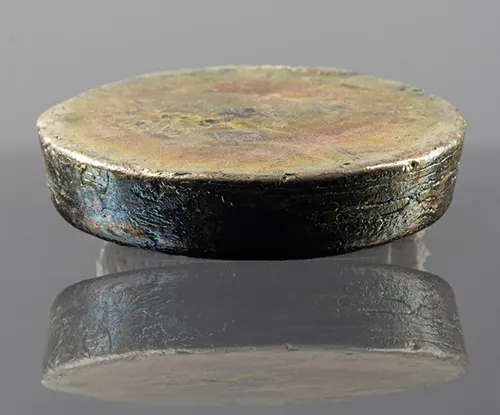
Bismuth is a pure chemical element. It consists of atoms with 83 protons and typically 126 neutrons in its naturally occurring stable isotope.
Bismuth exhibits metallic properties such as electrical conductivity, metallic bonding, and a crystalline structure. Although it behaves differently from many common metals, it remains firmly classified as a metal.
Yes, bismuth conducts electricity, although not as efficiently as metals such as copper or silver. Its electrical behaviour is unusual and makes it useful in specialised electronic applications.
Bismuth crystals often appear square or step-shaped because of their internal atomic arrangement. As molten bismuth cools, atoms arrange themselves into a rhombohedral lattice structure. The visible “square” shapes are actually layered growth patterns formed during crystallisation.
📖 History & Discovery
Bismuth was known in ancient times, but was often confused with lead and tin. It was recognised as a distinct element in the 18th century by the French chemist Claude François Geoffroy.
Although used much earlier, bismuth was formally identified as a separate element in 1753.
Bismuth resembles lead in colour and density. However, unlike lead, it expands when solidifying and is far less toxic.
🌍 Origin & Production
Bismuth is formed through stellar nucleosynthesis in supernova explosions. On Earth, it occurs naturally in mineral deposits, often alongside lead, copper, tin, and tungsten ores.
It occurs as native bismuth metal and in minerals such as bismuthinite and bismite. However, most commercial bismuth is recovered as a by-product during the refining of other metals.
Bismuth is not extremely rare in the Earth’s crust, but it rarely occurs in concentrated, mineable deposits. It is mostly produced as a by-product of other metals, which limits supply flexibility.
Bismuth has been recognised by major economies as strategically important due to supply concentration and growing industrial demand, particularly in lead-free technologies.
Bismuth is primarily recovered in countries that produce large volumes of base metals. Major producers include China, Mexico, Peru, and Bolivia.
China dominates global production, accounting for the majority of refined supply. Smaller quantities are produced in South America and parts of Europe.
Precise reserve data is limited, but the U.S. relies largely on imports to meet its bismuth requirements. Domestic production is very small and typically tied to the refining of other metals such as lead, copper, and tungsten. China dominates global supply, and because bismuth is mainly produced as a by-product, output cannot easily be increased. Given its importance as a non-toxic substitute for lead and its growing industrial uses, bismuth is considered strategically significant by Western governments and is officially listed as a critical mineral by the U.S. government.
⚙️ Uses & Applications
Bismuth has diverse applications, including lead-free solders and alloys, pharmaceuticals, cosmetics and pigments, fire detection systems, and nuclear & industrial research. Its non-toxicity makes it particularly valuable as a lead substitute.
Bismuth is unusual because it expands upon solidification (like water), is strongly diamagnetic, and forms striking geometric crystals. It is also among the least toxic heavy metals, making it valuable as a lead substitute.
Bismuth compounds are widely used in gastrointestinal treatments. They help protect the stomach lining and reduce inflammation.
Bismuth is not exceptionally rare in the Earth’s crust, but it is rarely mined directly. Most production comes as a by-product of other metal refining, which limits supply flexibility. When demand rises, particularly from pharmaceuticals, lead-free alloys, and electronics, production cannot simply be scaled up. Add to that the concentration of global supply in China, and tight markets with rising bismuth prices can develop quickly. In short, supply is structurally constrained while industrial demand remains steady.
🧪 Safety & Handling
Yes. Solid metallic bismuth is generally considered safe to handle. Unlike many heavy metals, it is non-toxic in elemental form.
Elemental bismuth is one of the least toxic heavy metals. However, as with all metals, compounds should be handled in accordance with safety guidelines.
Bismuth does not accumulate in the body in the same way as lead and has significantly lower toxicity. This makes it suitable for use in medical and consumer products.
💼 Buying, Investing & Storage
Industrial-grade bismuth is typically purchased through specialist metals dealers rather than retail marketplaces. Investors seeking certified material suitable for resale into industry must ensure proper documentation and chain of custody. At Strategic Metals Invest, we offer bismuth in certified, industry & investment-grade form, with full documentation and access to a resale network of industrial buyers.
Yes. Bismuth can be purchased in physical form as a tangible asset through industry suppliers. Through Strategic Metals Invest, private investors can purchase industry-grade bismuth, receive an ISO-9001-certified Certificate of Ownership, and opt for secure, tax-free storage. Because it is largely produced as a by-product, supply cannot easily expand to meet rising demand.
Industrial bismuth is stored in certified packaging within professional facilities to preserve quality and ensure resale eligibility.
Bismuth has gained attention as industries move away from toxic lead. It is used in solders, pharmaceuticals, and specialised alloys. Export restrictions in recent years have highlighted the concentration of supply, particularly in China.
Bismuth may not dominate headlines, but it’s easy to see why it’s becoming increasingly important. As industries move away from toxic lead and demand for safer, high-performance materials continues to grow, this distinctive metal is gaining strategic relevance.
From its formal identification in the 18th century to its modern-day role in pharmaceuticals, electronics, and lead-free alloys, bismuth has quietly become a dependable building block of modern manufacturing.
If you’d like to learn more about bismuth or explore owning it as a tangible asset, our team of experts is here to help.