
Weekly News Review February 9 – February 15 2026
February 15, 2026
Weekly News Review February 16 – February 22 2026
February 22, 2026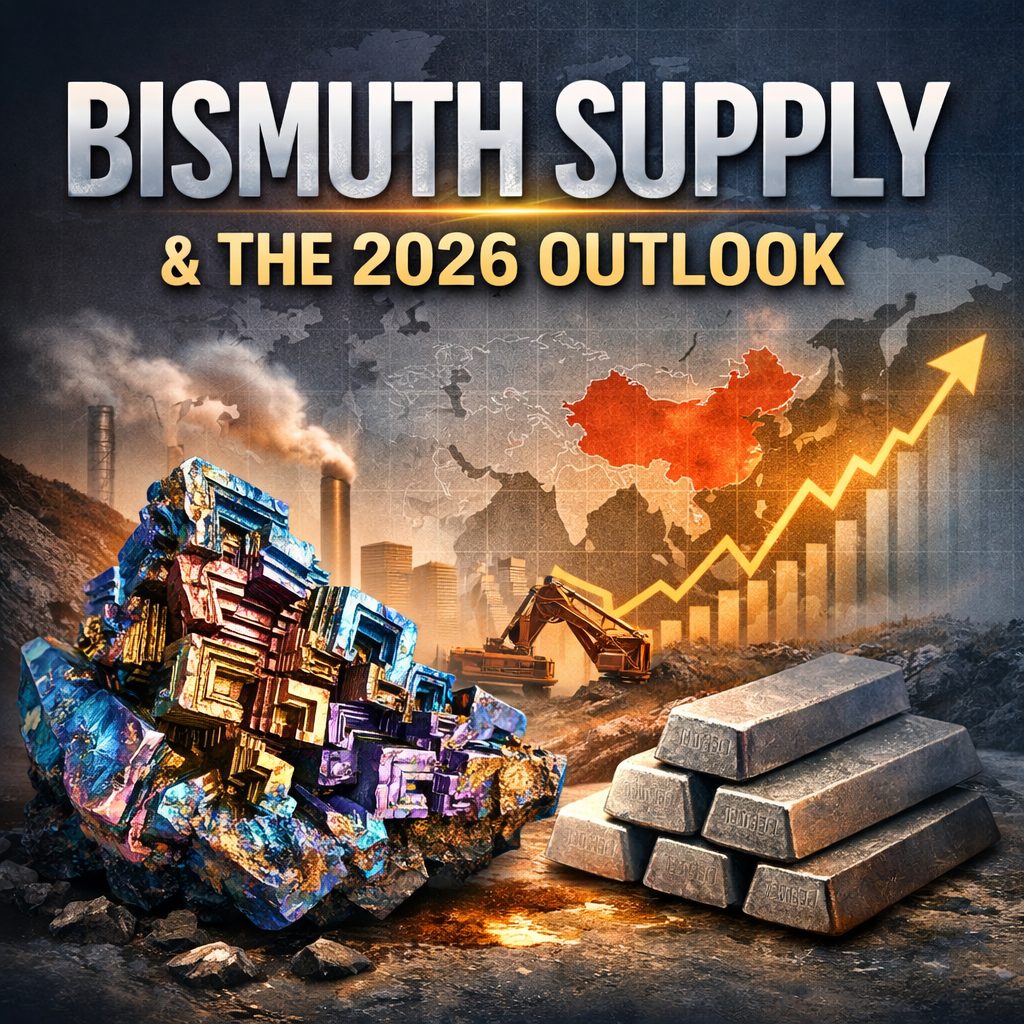
Strategic metals markets are increasingly shaped by access as much as price.
Over the past two years, export controls, licensing systems, and geopolitical positioning have altered how materials move across borders. In many cases, supply constraints emerge gradually, long before price movements fully reflect them.
Bismuth offers a clear example of this structural shift.
What Is Bismuth and Why Is It Strategically Relevant?
Bismuth is a post-transition metal primarily used in:
- Lead-free solders in electronics
- Pharmaceutical and medical applications
- Specialty alloys
- Certain defence and industrial uses
Unlike highly publicised rare earth elements, bismuth does not sit at the centre of a single breakthrough technology. Instead, it supports multiple established industries.
Its strategic relevance lies not in speculation, but in function.
Why Is Bismuth Supply So Concentrated?
Global annual bismuth production remains relatively small, under 20,000 tonnes per year.
China accounts for approximately 13,000 of the world’s 16,000 tonnes of annual output, making it the dominant producer.
Bismuth is rarely mined directly. It is typically produced as a byproduct of refining lead, copper, tin, tungsten, or silver. This means supply is dependent on broader mining activity rather than direct bismuth demand.
Production can respond to market conditions, but it cannot easily scale independently.
That structural characteristic makes the market inherently concentrated and relatively inflexible.
How Do Export Controls Affect Bismuth Availability?
In late 2024, China introduced export restrictions on certain bismuth products. These measures were tightened further in early 2025.
Since then, exports of high-purity material have declined and remain below previous levels.
The shift has not been chaotic. It has been selective.
For industrial consumers, the key question is increasingly reliability rather than short-term price volatility:
- Are export channels predictable?
- Can material be secured when required?
- How diversified is global production?
In a concentrated market, regulatory adjustments can have a disproportionate impact.
Industrial Demand Remains Structurally Anchored
Bismuth benefits from steady industrial demand across established sectors.
Environmental regulation has accelerated substitution of lead in certain applications, increasing the importance of bismuth in lead-free alloys and solders. At the same time, electronics manufacturing and medical applications continue to require high-purity material.
Unlike metals tied solely to emerging technologies, bismuth demand is not dependent on a single growth narrative. It is distributed across multiple industries.
That diversification supports structural relevance.
The 2026 Outlook: A Supply Structure Story
Three factors define the current landscape:
- Production remains geographically concentrated.
- Export controls have tightened.
- Global output is limited and largely byproduct-dependent.
In this environment, availability becomes a strategic variable.
Bismuth may not dominate headlines. Yet in a period where governments and industries are reassessing raw material security, smaller and less visible metals can carry outsized structural importance.
It is not a momentum story.
It is a supply structure story.
For current pricing data, historical performance, and storage details, visit: