Please note that the price provided above is the retail price for private investors and is aligned with industry retail pricing. For bulk tellurium purchases, whether investment or industry, please contact us directly for a quotation.
Tellurium has only recently been added to the core list of strategic metals available to private investors. Our IT team is currently working on the historical price charts, and we’ll display them here as soon as they’re available.
In the meantime, it’s worth noting that tellurium prices have traditionally been shaped by limited market transparency and a relatively small, specialised buyer base.
To better understand tellurium’s future price potential, let’s explore its key applications and the sources of global production (click here to jump to the forecast).
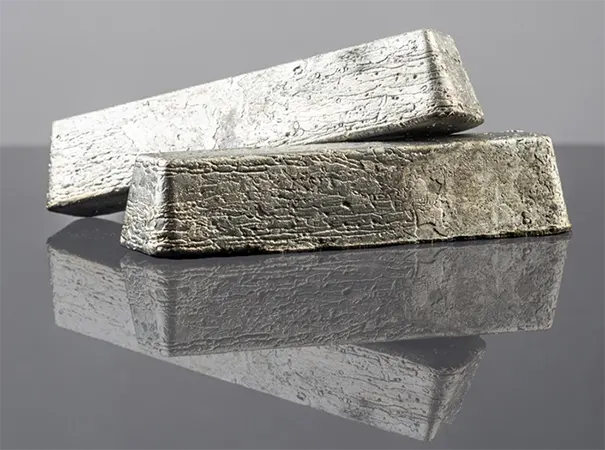
Tellurium is a rare technology metal that is primarily produced as a by-product of copper refining. It is characterised by its brittle nature, metallic lustre, and semiconducting properties, and is typically silvery-white in appearance. Tellurium is identified by the chemical symbol Te and atomic number 52.

The applications of tellurium are closely tied to its unique electrical and chemical properties. As a semiconducting element, tellurium plays an important role in several advanced technologies, particularly where efficiency and performance are critical.
One of the most significant uses of tellurium is in thin-film solar cells, specifically cadmium telluride (CdTe) photovoltaic technology. These solar panels are widely used in large-scale solar installations due to their cost efficiency, high energy yield, and relatively low material intensity compared to conventional silicon-based panels.
Tellurium is also used in the electronics and semiconductor industries, where it improves conductivity and performance in certain alloys and compounds. It is applied in thermoelectric devices, which convert heat directly into electricity and are used in specialised power generation and cooling applications.
In metallurgy, tellurium is added in small quantities to steel, copper, and lead alloys to enhance machinability and material performance. These applications are particularly relevant in industrial manufacturing where precision and durability are required.
Beyond these established uses, tellurium is gaining importance in emerging technologies, including advanced electronics and energy storage systems. As demand for renewable energy and high-efficiency electronic components continues to grow, tellurium’s role as a critical enabling material is becoming increasingly strategic.
Tellurium occurs in extremely low concentrations and does not form standalone deposits. Instead, it is produced almost exclusively as a by-product of copper refining, recovered from anode slimes during the electrolytic refining process. As a result, tellurium supply is inherently tied to global copper production rather than to demand for tellurium itself.
Global tellurium production is relatively small, with annual output estimated at under 1,000 tonnes. The majority of this production comes from China, which dominates both refining capacity and downstream processing. Smaller quantities are produced in countries with significant copper refining industries, including the United States, Japan, Peru, and Canada.
Because tellurium is dependent on copper output and concentrated refining infrastructure, supply cannot be scaled up quickly. This structural constraint plays a key role in shaping tellurium availability, and, by extension, its price behaviour.
Simply put, the price of tellurium is determined by the law of supply and demand, just as it is for other commodities.
Tellurium has become increasingly important to several industries. Rising demand for end products in these sectors, particularly solar energy, electronics, and advanced manufacturing, directly increases demand for this highly specialised metal.
On the supply side, tellurium is considered rare due to its limited natural availability and constrained production model. It occurs in very low concentrations and is produced almost exclusively as a by-product of copper refining. This means tellurium supply cannot be expanded independently and is largely fixed by copper production levels, making the market especially sensitive to shifts in demand and regulatory changes.
Tellurium sits among the more structurally constrained technology metals, with pricing shaped less by trading volume and more by supply rigidity, regulatory intervention, and long-term industrial demand. Unlike larger commodity markets, tellurium pricing tends to adjust in discrete steps rather than continuous moves, reflecting its small market size and by-product production model.
A defining development for tellurium came in early 2025, when China introduced export controls on tellurium products (Reuters). While these measures stopped short of a full export ban, they tightened oversight and added friction to international supply flows, reinforcing tellurium’s status as a policy-sensitive material.
Given that tellurium is produced almost exclusively as a by-product of copper refining, and that China dominates global refining capacity, such regulatory actions have an outsized impact on availability outside China.
On the demand side, tellurium’s role in cadmium telluride (CdTe) thin-film solar cells continues to anchor long-term consumption. CdTe technology remains a key solution for utility-scale solar installations due to its cost efficiency and strong performance in high-temperature conditions, and has been highlighted by the International Energy Agency as part of the global clean-energy transition.
Beyond solar energy, tellurium demand is supported by electronics, thermoelectric applications, and specialty alloys. These end uses align closely with energy transition policies and industrial electrification trends, particularly in the U.S. and Europe.
These dynamics are also highlighted by the U.S. Geological Survey’s Tellurium Mineral Commodity Summary, which notes tellurium’s concentrated supply, by-product production model, and growing importance in clean-energy technologies.
With supply rigid and demand linked to structurally supported sectors, the medium-term outlook for tellurium remains constructively firm.
Export controls in China introduced additional administrative oversight on tellurium shipments, reinforcing supply tightness outside domestic Chinese markets.
Renewable-energy momentum continued to underpin demand, with CdTe solar technology retaining a meaningful share of new utility-scale installations.
Strategic reassessment: tellurium’s importance in clean-energy supply chains prompted renewed attention from policymakers after earlier proposals to downgrade its criticality were reversed.
Tellurium is best understood as a market where supply is structurally capped rather than cyclically flexible. Because production depends on copper refining volumes, higher tellurium prices do not automatically lead to higher output. This creates a market dynamic where regulatory shifts or incremental demand growth can have disproportionate price effects.
At the same time, demand from solar energy and advanced electronics is long-term in nature, tied to infrastructure build-out rather than short consumer cycles.
Price drivers tilting upward
China’s export-control framework, which shapes global tellurium availability.
Persistent demand from CdTe thin-film solar cells used in utility-scale projects.
Limited ability to expand supply due to by-product production constraints.
Growing strategic focus on secure clean-energy supply chains.
Potential headwinds to watch
Copper market cycles, which indirectly affect tellurium output volumes.
Technological substitution risk in photovoltaics over longer time horizons.
Periodic pauses in large-scale solar deployment linked to policy or financing cycles.
Bias: Firm with episodic volatility
Rationale:
Export oversight continues to constrain non-Chinese supply.
Solar demand remains stable enough to absorb available material.
Thin liquidity amplifies short-term price reactions to supply news.
Bias: Gradual upward drift with step-changes
Rationale:
Structural supply rigidity persists.
Clean-energy investment cycles provide a steady demand floor.
Limited new refining capacity outside China keeps the market tight.
Bias: Constructive, supply-constrained upside case
Rationale:
Tellurium’s by-product nature caps expansion potential.
CdTe solar technology remains relevant in global energy-transition scenarios.
Long lead times for alternative supply chains limit downside flexibility.
Structurally scarce supply: production cannot respond quickly to higher demand.
Policy sensitivity: regulatory changes can materially affect pricing.
Energy-transition relevance: direct exposure to solar and electrification trends.
Small-market dynamics: modest shifts in demand or supply can drive outsized price moves.

Companies such as First Solar, Intel, Panasonic, and LG rely on globally licensed specialty metals dealers when sourcing tellurium for industrial use. These trusted intermediaries serve as the link between high-tech manufacturers and producers of strategic and technology metals that underpin advanced electronics and clean-energy systems.
Smaller quantities of tellurium can sometimes be found via online platforms such as eBay, Alibaba, or Amazon. However, this route is generally suited to hobbyists or laboratory use rather than to industrial buyers or investors, as material purity, provenance, and resale options are often unclear.
Reputable metals dealers like ourselves provide full chain-of-custody documentation, guaranteeing industrial-grade purity (min. 99.99%) and traceability. We also arrange professional storage under controlled conditions, ensuring that investors can hold tellurium securely and maintain optimal resale potential over the long term.
Unlike some base or precious metals, tellurium is not traded on a liquid futures exchange. Pricing is determined through direct transactions within the industrial market, making access via established dealers essential for both transparency and reliability.
For holders of industrial-grade tellurium, the only practical route to resale is through reputable industry suppliers. This is because professional buyers require verified chain-of-custody documentation, purity analysis, and traceability, which are typically only available when material has been sourced and stored through established market participants.
If tellurium was purchased via an online marketplace such as eBay, Amazon, or Alibaba, resale options are usually limited to other private buyers or hobbyists. In such cases, achieving prevailing industrial market prices is unlikely, as provenance, purity, and resale suitability cannot easily be verified.
By contrast, investors who hold tellurium through us benefit from clear resale pathways into the industrial market. Because the material is already documented, certified, and professionally stored, liquidation can typically be arranged efficiently and at prices aligned with current market conditions.
All prices on this page last updated Feb 02 2026.