


Rhenium Prices
Current Rhenium price: $7,283.30 per kg.
Price as of Jul 16 2026. The price shown above is the retail price for private investors and is aligned with industry retail pricing. For bulk rhenium purchases, whether for industrial use or investment, please contact us for a quotation.
Rhenium price performance over time
| Period | Rhenium price then | Change to today |
|---|---|---|
| Current price | $7,283.30/kg | — |
| 1 year | $3,168.90/kg | +129.84% |
| 2 years | $2,251.40/kg | +223.50% |
| 3 years | $1,611.90/kg | +351.85% |
| 5 years | $1,536.90/kg | +373.90% |
| 10 years | $2,389.40/kg | +204.82% |
Rhenium Historical Price Movement
Rhenium prices are increasingly shaped by the strategic importance of this exceptionally heat-resistant metal in aerospace and other high-performance industrial uses.
At today’s price of $7,283.30 per kg, rhenium is up 52.99% year to date, up 192.98% since the start of 2025, up 265.08% since the start of 2024, and up 325.55% since the start of 2020, when the rhenium price stood at $1,711.50 per kg.
This reflects rhenium’s importance in aircraft turbines, rocket-related applications, petrochemical catalysts, and other extreme-temperature environments, combined with a market where scarcity, by-product production, and limited substitution options can tighten supply quickly.
Rhenium annual price performance
| Current Rhenium Price/kg |
2026 YTD | 2025 | 2024 | 2023 | 2022 | 2021 | 2020 |
|---|---|---|---|---|---|---|---|
| $7,283.30 | 52.99% | 91.50% | 24.61% | 24.18% | -7.14% | 23.14% | -17.91% |
Rhenium is an extremely rare and dense chemical element with atomic number 75, which makes it a part of the transitional metals group. It has a silver-grey appearance and melts at an incredibly high temperature of 3,186 degrees Celsius / 5,767 Fahrenheit.
Let’s look at the various uses of rhenium and who produces it first in order to make an educated forecast on its future price (or click here to jump to the rhenium forecast).
Rhenium Uses
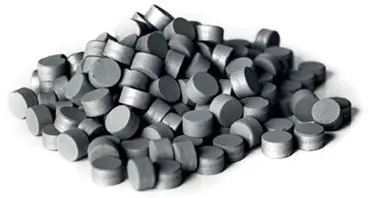
Rhenium’s remarkable properties make it indispensable across some of the world’s most advanced industries, from aerospace and defense to energy, electronics, and medicine.
Aerospace & Defense
Rhenium’s extreme heat resistance and tensile strength make it a key ingredient in the superalloys used for jet engine turbines, rocket nozzles, and combustion chambers. These nickel-based alloys typically contain up to 6% rhenium, which dramatically improves performance and durability at temperatures exceeding 1,000 °C. The metal is also used in tungsten-rhenium thermocouples, crucial for precise temperature measurements in high-performance engines.
Energy & Catalysis
Rhenium is a cornerstone of modern refining technology. When added to platinum catalysts, it enhances efficiency and longevity in oil refining and fuel-reforming processes, reducing energy consumption and emissions. It also contributes to next-generation combustion systems in both power plants and industrial gas turbines, helping to improve efficiency and lower environmental impact.
Electronics & Technology
Rhenium’s excellent conductivity and stability make it ideal for electrical contacts, filaments, and electrodes. It is used in mass spectrometers, X-ray tubes, and specialised high-temperature electronic components, where reliability under stress is essential.
Medical & Research Applications
In the medical field, rhenium is gaining ground as a radiotherapeutic isotope. Rhenium-186 and Rhenium-188 are used in targeted cancer treatments and radiolabeled compounds for tumor imaging. These innovations are expanding rhenium’s role from an industrial material to a life-saving medical resource.
Emerging & Future Uses
As research intensifies, new applications continue to emerge, from additive manufacturing (3D-printed superalloys) to advanced coatings and quantum technologies. With no viable substitutes and an expanding range of uses, rhenium’s strategic importance is expected to grow significantly in the coming decade.
Where is Rhenium Produced?
Rhenium is the rarest stable element in the Earth’s crust, occurring at well below one part per billion. It is never found in mineable concentrations of its own and must be recovered as a by-product, primarily during the processing of molybdenum concentrates from large porphyry copper deposits. These ores typically contain only 0.001% to 0.2% rhenium, which makes extraction technically demanding and economically sensitive.
Global primary production remains extremely limited. The backbone of supply comes from just a handful of countries:
Chile: by far the most important source, thanks to its enormous copper industry and associated molybdenum recovery.
United States: primarily from molybdenum operations in Arizona, Utah, and Colorado.
Kazakhstan, Poland, and China: smaller but still meaningful contributors to global refinery output.
In total, annual worldwide production is estimated at around 40–50 tonnes of newly recovered rhenium, with an additional 12–15 tonnes coming from recycling and catalyst recovery. Even when combined, the entire global market sits at only ~62 tonnes per year, meaning any disruption, whether from Chilean copper politics, refinery maintenance, or shifts in aerospace demand, can have an outsized effect on price and availability.
Because rhenium extraction depends on the economics of copper and molybdenum mining rather than its own supply-demand fundamentals, production cannot easily scale in response to rising demand. This structural constraint is one of the key reasons rhenium remains both strategically important and persistently scarce.
What Factors Determine the Price of Rhenium?
Rhenium’s price is shaped by a combination of extreme scarcity, inflexible supply, and high-intensity industrial demand. Because the market is so small, barely 62 tonnes of annual supply worldwide, even modest shifts in consumption can trigger outsized price movements.
Demand-Driven Volatility
Rhenium is essential in jet engines, rocket nozzles, gas turbines, catalysts, and other high-temperature systems where no substitute exists. When demand rises from aviation, aerospace, or energy technologies, the market feels it immediately. Large order cycles from aircraft manufacturers or refiners can push prices sharply higher.
Constrained Supply
Supply is inherently tight because rhenium is not mined directly. It is recovered only as a by-product of molybdenum production, which itself is tied to global copper mining. This means rhenium output cannot easily increase when demand rises; production is dictated by copper and molybdenum markets, not by rhenium’s own price signal.
The extraction and recovery process is technically complex and expensive, further limiting how much material can economically reach the market.
Limited Dependence on China
Unlike rare earths and many other strategic metals, the rhenium supply chain is not dominated by China. While China is among the top producers, its output is largely consumed domestically. For Western industries, the critical suppliers remain Chile, the United States, Kazakhstan, and Poland.
This makes rhenium one of the few critical metals not directly exposed to Chinese export restrictions, but it doesn’t make the market any less fragile. Its bottleneck is geological and metallurgical, not geopolitical.
Rhenium Price Forecast
At a glance
- Rhenium had a very strong 2025 and kept climbing into 2026. It rose 91.5% in 2025, then added another 34.2% in Q1 2026.
- This is not simply a short-term spike. Rhenium is an exceptionally small and structurally tight market, where even moderate changes in demand can cause disproportionately large price moves.
- Unlike some other strategic metals, rhenium is not mainly a China export-control story. But that does not make it secure or abundant. Supply is still fragile because rhenium is produced almost entirely as a by-product of copper and molybdenum processing.
- At the same time, industrial demand remains firm, led above all by aerospace, where rhenium is used in high-performance superalloys for aircraft engines and gas turbines.
- The market also became more strategically important in 2025, with rhenium added back to the U.S. critical minerals list, underlining that it is no longer just a niche industrial metal but an increasingly important supply-security metal.
What changed for Rhenium in 2025 and Q1 2026
The rhenium market tightened materially in 2025 and stayed strong into Q1 2026, rising from $2,485.90/kg at the start of 2025 to $6,389.30/kg by 31 March 2026.
This was not a speculative blow-off in the usual sense. The industrial backdrop tightened materially. USGS notes that 2025 consumption rose faster than production, and that several molybdenum-rhenium medical devices were approved by the FDA, underlining that rhenium demand is no longer only an aerospace-and-catalyst story. It is still led by aerospace, but it is becoming broader at the margin.
At the same time, rhenium’s strategic importance became more explicit. In November 2025, the U.S. added rhenium back to its final Critical Minerals list, a notable signal that Washington now sees the metal as economically and strategically important enough to monitor more closely.
Meanwhile, the aviation demand story has not cooled. Airbus now forecasts demand for 43,420 new passenger and freighter aircraft over the next 20 years, while Boeing says passenger traffic will more than double, and the global fleet will nearly double over the same period. Rhenium does not go into every aircraft equally, but the broader direction is obvious: more engines, more turbine materials, and more pressure on metals that are hard to substitute.
What this means for Rhenium
The underlying logic has not changed, but the market has become more extreme.
Rhenium remains one of the clearest examples of scarcity by structure. It is not mined directly, it is produced in very small volumes, and its availability depends on activity in other metals markets rather than on its own price. That means even moderate demand growth can cause disproportionate price moves.
The other important point is that rhenium now offers a slightly different strategic profile from the China-dominated rare earth story. It is still affected by geopolitics, but more through aerospace demand, strategic classification, and procurement behaviour than through a simple export-ban narrative. That makes it a useful diversifier within a strategic-metals basket, while still retaining the scarcity and industrial-necessity characteristics that matter.
Price drivers tilting upward
- Commercial aerospace demand remains the main long-term support. Rhenium’s key role in turbine superalloys keeps it closely tied to aircraft-engine production and maintenance.
- Supply remains structurally inflexible. Rhenium is not mined directly, so higher prices do not automatically bring large new volumes to market.
- The market is extremely small. In a metal this small, even modest changes in buying behaviour can move prices sharply.
- Strategic relevance has increased. Rhenium’s return to the U.S. critical minerals list is a notable sign that governments now view it through a supply-security lens as well as an industrial one.
- Industrial demand is broadening slightly. Aerospace remains dominant, but catalysts, gas turbines, and newer specialised applications such as medical devices add to the overall support.
- Substitution remains difficult. In the most demanding high-temperature uses, rhenium still has few realistic alternatives without performance loss.
Potential headwinds to watch
- After such a sharp move, some consolidation would be normal. Rhenium is a specialist market, and sharp repricing phases are often followed by quieter periods.
- A slowdown in aircraft production or industrial activity could soften near-term buying. The long-term case may stay intact while short-term procurement becomes more cautious.
- Higher prices can encourage more recycling and secondary recovery. That may not solve the structural tightness, but it can reduce the pace of further spikes.
- The market is not highly liquid in the exchange-traded sense. That can increase short-term volatility in both directions.
- As a by-product metal, supply can sometimes improve at the margin if underlying copper or molybdenum production rises. That would not flood the market, but it could ease pressure somewhat.
6–12 month Rhenium forecast view
Bias: Constructively bullish with volatility
Rationale:
Rhenium still looks tight in the near term. The market has already repriced hard, so some digestion or pullback would be normal, but the combination of small supply, strong aerospace demand, broader strategic attention, and a lack of easy substitution suggests the underlying bias remains upward rather than exhausted. This is more likely to be a higher-lows market than a straight-line surge.
12–24 month forecast view
Bias: Bullish
Rationale:
Over the next one to two years, rhenium should remain supported by the same core drivers: aircraft demand, turbine applications, catalysts, and slowly expanding medical uses. On the supply side, there is still no realistic way to flood the market because rhenium output is tied to copper and molybdenum production rather than to rhenium’s own price. That points to continued tightness and a structurally higher pricing regime than the market was used to before 2024.
3–5 year forecast view
Bias: Strongly bullish, but cyclical
Rationale:
Rhenium still fits the classic strategic-metals pattern extremely well: it is industrially critical, difficult to substitute, tiny in market size, and constrained by by-product production. If global aviation growth unfolds anywhere near current Airbus and Boeing expectations, and if strategic procurement behaviour continues to expand, average rhenium prices should remain well above the old pre-2024 range, even if the path includes corrections and pauses.
Why physical Rhenium fits the Strategic Metals Invest playbook
Rhenium fits the Strategic Metals Invest playbook unusually well because it combines several of the qualities that matter most in this asset class.
It is a tiny market tied to real industrial demand rather than financial speculation. It is exceptionally difficult to replace in its most important uses. It is not mined directly, which makes supply unusually inflexible. And because it trades through specialist industrial channels rather than public exchanges, documented purity, proper storage, and chain of custody matter much more than they do in mainstream commodity markets.
In other words, rhenium is exactly the kind of metal that can remain under-recognised for years, then suddenly become highly relevant when demand strengthens in a market that has almost no spare flexibility. That combination of industrial necessity, constrained availability, and specialist resale logic is precisely what makes physical strategic metals interesting in the first place.
How to Buy Rhenium
With its high melting point and impressive mechanical properties, rhenium is a coveted material in many industries. To ensure they get the best quality available, major corporate buyers such as Boeing, Airbus, and NASA tend to rely on renowned metal dealers who are able to source industry-grade rhenium of 99.9% purity or higher.
By guaranteeing product provenance, these so-called ‘key intermediaries’ also make it possible for global companies to access hard-to-find rare earth elements quickly and safely – something not achievable by buying online through less reputable channels like Amazon or Alibaba.
Rhenium should only be purchased from trusted sources that can deliver certifiable levels of quality control; otherwise, the metal can only be liquidated to hobbyists. We’re the only globally licensed industry supplier offering private investors the option to purchase and safely store industry-grade rhenium. Hence any discerning investor who wants to own some and benefit from potential future price increases can do this safely with us.
Rhenium futures contracts are also traded on the Shanghai Metal Market (SMM).
How to Sell Rhenium
If you have some rhenium at home, you should be able to sell it to other hobbyists via online marketplaces like eBay, Alibaba, and Amazon. The price you get will depend on what they offer, but it won’t be anywhere near the market price.
When it comes to selling industrial-grade rhenium, buyers like Lockheed Martin, SpaceX, and Boeing require more than just a secure transaction. To ensure that only quality materials are circulated in their production processes, they source their supply from trustworthy suppliers who can present documentary evidence of how each metal has been managed since its production – known as the chain of custody. That’s why they don’t shop on eBay.
Our investors can be confident that the liquidation of their strategic metals to industry buyers is secure and swift, as we are such a trusted industry supplier.
All prices on this page last updated Jul 16 2026.