

A Critical Material for Energy Storage and Defence Applications
Antimony is a silvery-grey metalloid that has been used for thousands of years, yet its industrial relevance has never been greater. From flame-retardant materials and lead-acid batteries to defence applications and specialised alloys, antimony plays a vital role in modern manufacturing.
Below, we answer the most frequently asked questions about antimony, covering its properties, history, production, uses, and strategic relevance.
🔬 Properties & Physical Behavior
Antimony is a silvery-grey, brittle metalloid. It shares properties of both metals and non-metals, which is why it is classified as a metalloid rather than a pure metal.
In its pure form, antimony is a bright, silvery-grey solid with a flaky, crystalline structure. It is brittle and breaks easily, unlike ductile metals such as copper.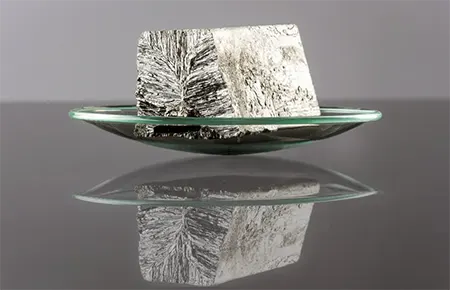
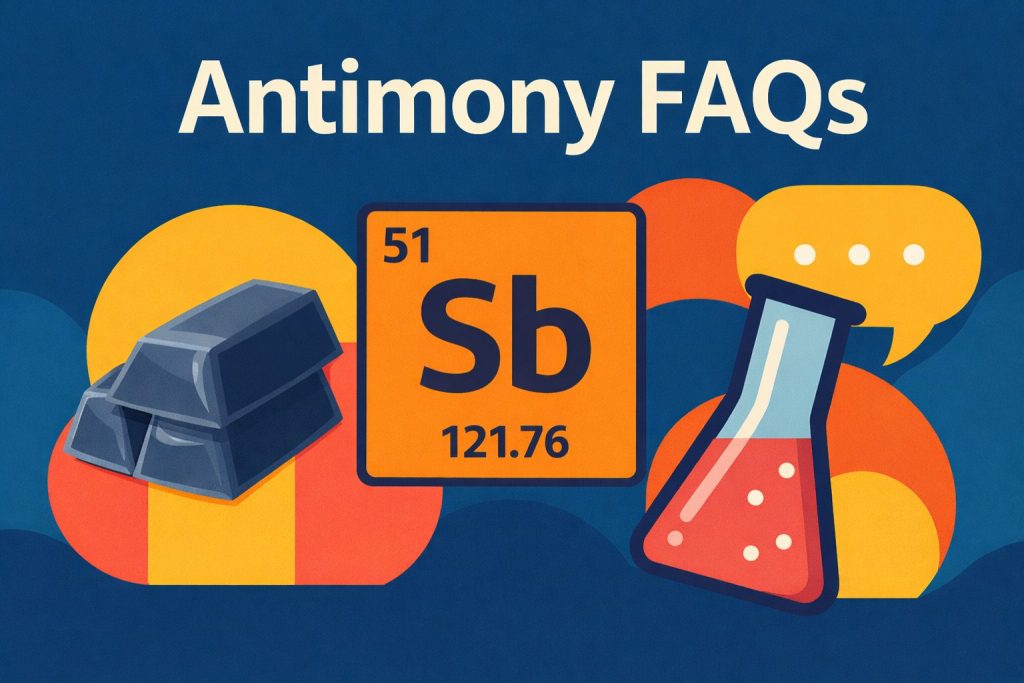
Antimony is element number 51 with the chemical symbol Sb. It belongs to Group 15 of the periodic table, alongside nitrogen, phosphorus, arsenic and bismuth.
Antimony is in Group 15 (the pnictogens). Elements in this group display a mix of metallic and non-metallic characteristics.
The symbol Sb comes from the Latin word stibium, the ancient name for antimony sulphide, which was widely used in early civilisations.
The name derives from historical terms linked to the mineral stibnite. Over centuries, it evolved into the modern name “antimony”.
📖 History & Discovery
Antimony has been known since ancient times. It was used in cosmetics and medicines in Egypt and the Middle East thousands of years ago. It was formally recognised as an element in the 17th century.
While antimony compounds were used in antiquity, it was first described scientifically by the Italian alchemist Vannoccio Biringuccio in the 16th century.
Early metallurgists isolated antimony by heating its primary ore, stibnite (antimony sulphide), and separating the metal through smelting techniques.
Antimony was not discovered in a single location, as it was known in multiple ancient civilisations. Its scientific identification developed gradually in Europe during the Renaissance period.
🌍 Origin & Production
Antimony is not extremely rare in the Earth’s crust, but it is rarely found in large, concentrated deposits. Most commercially viable deposits are limited and geographically concentrated.
Antimony is primarily found in the mineral stibnite. It occurs in hydrothermal veins and is often associated with gold, silver, and base metal deposits.
Antimony mining is concentrated in China and parts of Central Asia. In Western countries, production is minimal and often dependent on recycling or small-scale operations.
Antimony is most commonly produced from the mineral stibnite (antimony sulphide). The ore is mined, often from underground deposits, then crushed and concentrated. It is typically roasted to form antimony oxide, which is subsequently reduced (often using carbon) to produce metallic antimony. In some cases, antimony is also recovered as a by-product from gold or other base metal operations.
China is the dominant exporter, with additional exports from Russia and Central Asian producers. Export controls and policy decisions can significantly affect global supply.
Precise reserve figures are limited, but the United States currently has very little active domestic antimony production. Most U.S. demand is met through imports, historically from China and, more recently, from other foreign suppliers. While antimony deposits exist within the U.S., large-scale mining and refining capacity is minimal.
Because antimony is essential for flame retardants, lead-acid batteries and defence applications, it is officially classified as a critical mineral by the U.S. government.
⚙️ Uses & Applications
Antimony is primarily used in flame retardants, lead-acid batteries, alloys, semiconductors, and military applications. Its ability to harden lead and improve fire resistance makes it industrially valuable.
Antimony compounds are found in flame-retardant plastics, battery alloys, pigments and some specialised glass and ceramics.
Antimony is added to lead in ammunition to increase hardness and durability. This improves performance and structural integrity.
Several factors contribute to antimony’s elevated price:
– Global production is highly concentrated, with the majority of supply coming from China.
– It is mined in relatively limited quantities compared to many base metals.
– It plays a critical role in flame retardants, lead-acid batteries, and defence applications.
– Export controls, environmental restrictions, and policy decisions can quickly tighten supply.
– Western economies have minimal domestic production, increasing reliance on imports.
In short, supply is concentrated and strategically sensitive, while industrial demand remains steady.
🧪 Safety & Handling
In metallic form, antimony is relatively stable. However, certain antimony compounds can be toxic if inhaled or ingested in large quantities.
Toxicity concerns mainly relate to inhalation of dust or exposure to certain chemical compounds. Industrial handling requires appropriate safety measures.
💼 Buying, Investing & Storage
Antimony is not traded on public exchanges in the way gold or copper are. Physical ownership typically requires purchasing through specialist industry dealers who provide certified material suitable for industrial resale. At Strategic Metals Invest, we provide structured access to physical antimony, including professional-grade packaging, secure storage, and a clear resale pathway back into industrial markets.
Industrial-grade antimony isn’t something you’ll find through general online marketplaces. If you’re considering physical ownership, it’s important to purchase from a specialised supplier that provides certified, investor-ready material. At Strategic Metals Invest, we offer high-purity antimony in professional industrial form, complete with full documentation and optional secure storage.
Metallic antimony is stable under normal conditions. However, due to its strategic importance and concentrated supply, professional storage is recommended for long-term holders. Our METLOCK facility in Germany offers high-security storage with full documentation, insurance coverage, and preservation standards consistent with industrial custody requirements.
Antimony may not be as widely recognised as copper or lithium, but its importance is clear. As demand for flame-retardant materials, battery technologies, and defence applications continues to grow, this strategically significant metalloid remains firmly embedded in modern industry.
From its ancient use in cosmetics to its role in today’s energy storage and security systems, antimony has evolved into a material of structural importance. With supply heavily concentrated and global demand steady, it occupies a unique position among critical raw materials.
If you’d like to learn more about antimony or explore owning it as a tangible asset, our team of experts is ready to assist you.