
Weekly News Review February 23 – March 1 2026
March 1, 2026
Weekly News Review March 2 – March 8 2026
March 8, 2026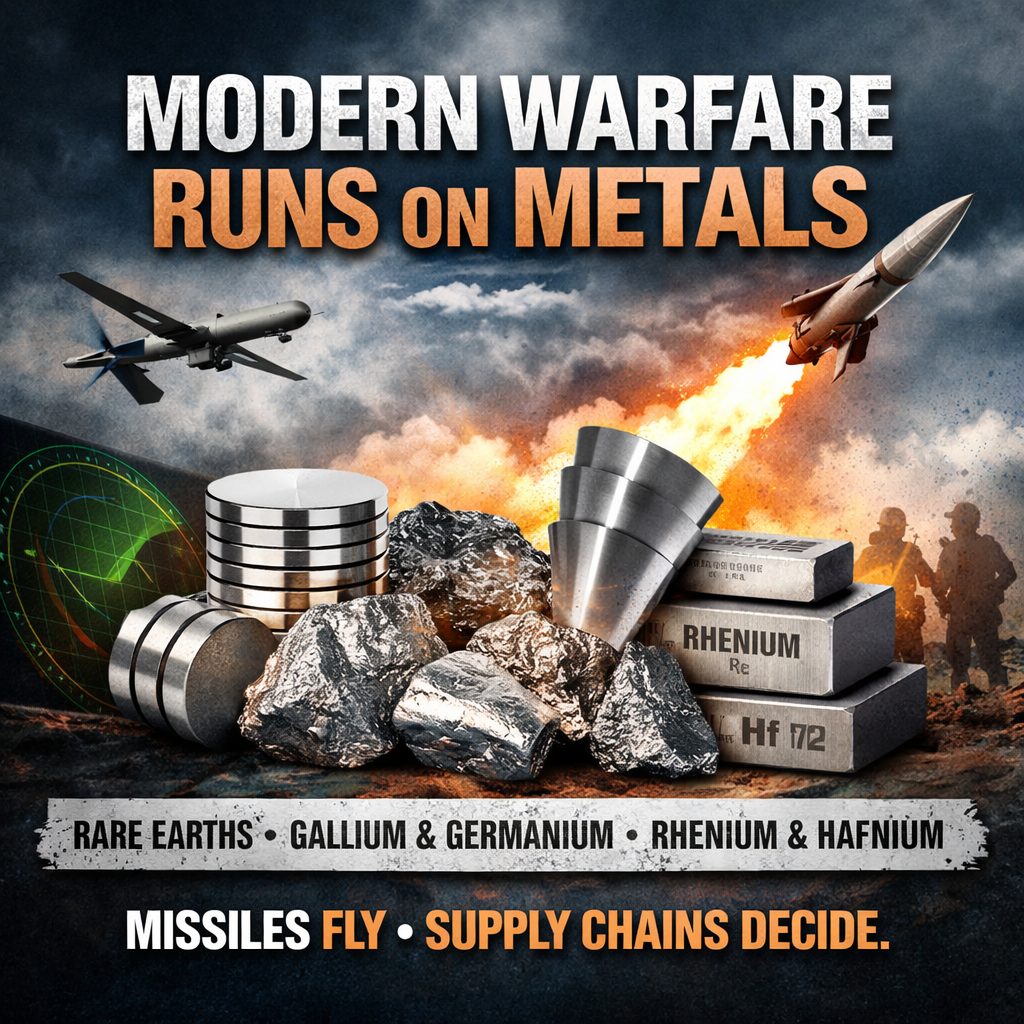
Recent tensions between the United States, Israel, and Iran have once again reminded markets how quickly geopolitical risk can escalate.
Much of the media coverage focuses on oil prices, military strategy, and defense stocks. Yet behind every missile system, drone platform, radar installation, and interceptor battery lies something far less visible but equally critical: the materials that make these technologies possible.
Modern defense systems are not only a question of engineering and budgets. They are also a question of supply chains.
From rare earth magnets used in guidance systems to specialised alloys in jet engines and infrared optics in surveillance equipment, a range of strategic metals quietly underpin the technologies that define modern warfare.
Understanding these materials helps explain why governments increasingly view certain metals not just as industrial inputs, but as strategic assets.
The current conflict highlights a reality that has been building for years: modern security is increasingly linked to material security.
1) Why this matters for strategic metals
When conflict becomes kinetic (missiles launched, drones deployed, interceptors fired), demand is no longer a budget-line projection. It becomes consumption, replacement, and stockpiling.
That matters because many defense-relevant inputs are not exchange-traded commodities. They are specialist materials used inside electronics, propulsion, optics, and guidance systems, sourced through industrial supply chains rather than public markets.
And those supply chains are often concentrated and slow to expand.
2) The “metal layer” of modern warfare (in plain English)
Here are some of the key metal families that sit behind today’s defense systems:
Rare earth magnets (drones, actuators, guidance, precision systems)
Modern weapons and defense platforms rely heavily on compact, high-performance motors and actuators. That’s where rare earth permanent magnets come in, particularly in drones, precision guidance, stabilization systems, and a wide range of aerospace components.
Heavy rare earths like dysprosium and terbium are especially important because they improve magnet performance in high-stress, high-temperature environments, i.e., conditions that frequently appear in aerospace and military applications.
Gallium & Germanium (radar, communications, sensors, optics)
Today’s battlefield is data-driven. Radar, secure communications, electronic warfare, and advanced sensing all depend on specialized semiconductors and optics.
Gallium (especially in high-performance semiconductor formats) is closely linked to modern radar and high-frequency communications.
Germanium plays a crucial role in infrared optics and sensing; think night vision, thermal imaging, and certain surveillance and targeting systems.
Rhenium & Hafnium (aerospace turbines, high-temperature alloys, extreme-performance engineering)
Some of the most demanding defense applications occur in environments where heat and stress are brutal: jet engines, turbine blades, and high-performance aerospace systems.
Rhenium is a textbook “small market, big consequences” material. Tiny quantities materially improve superalloy performance, and supply is tight because it is largely produced as a by-product.
Hafnium is also notable in high-temperature and high-reliability environments, including aerospace systems and certain specialized industrial components where material performance is non-negotiable.
3) Conflict is also a logistics story
Even when metals exist, the real question during periods of escalation is: can they move reliably and quickly through the supply chain?
Licensing regimes, shipping routes, insurance, and refinery bottlenecks can become just as important as mine output. In other words, availability is not only a geological question but also a political and logistical one.
4) Defense stocks vs. the underlying materials
Defense stocks can perform well in volatile periods, but they also come with familiar equity-market baggage:
- broader market selloffs
- valuation swings
- political headlines
- contract timing and budget cycles
Strategic metals sit in a different lane. They are physical inputs. And when governments and manufacturers decide supply security matters, they tend to act in the industrial market first (contracts, reserves, allocations), not on a stock chart.
Or said more bluntly:
When the world gets rough, you don’t want to be guessing what a multiple “should” be. You want to understand what the supply chain can actually deliver.
If you’d like, we can share a short educational overview of a defence-relevant “materials basket” (focused on industrial relevance and supply structure) and explain how physical ownership and professional storage work in practice. Simply contact us, and we can arrange a short call.