
Weekly News Review March 16 – March 22 2026
March 22, 2026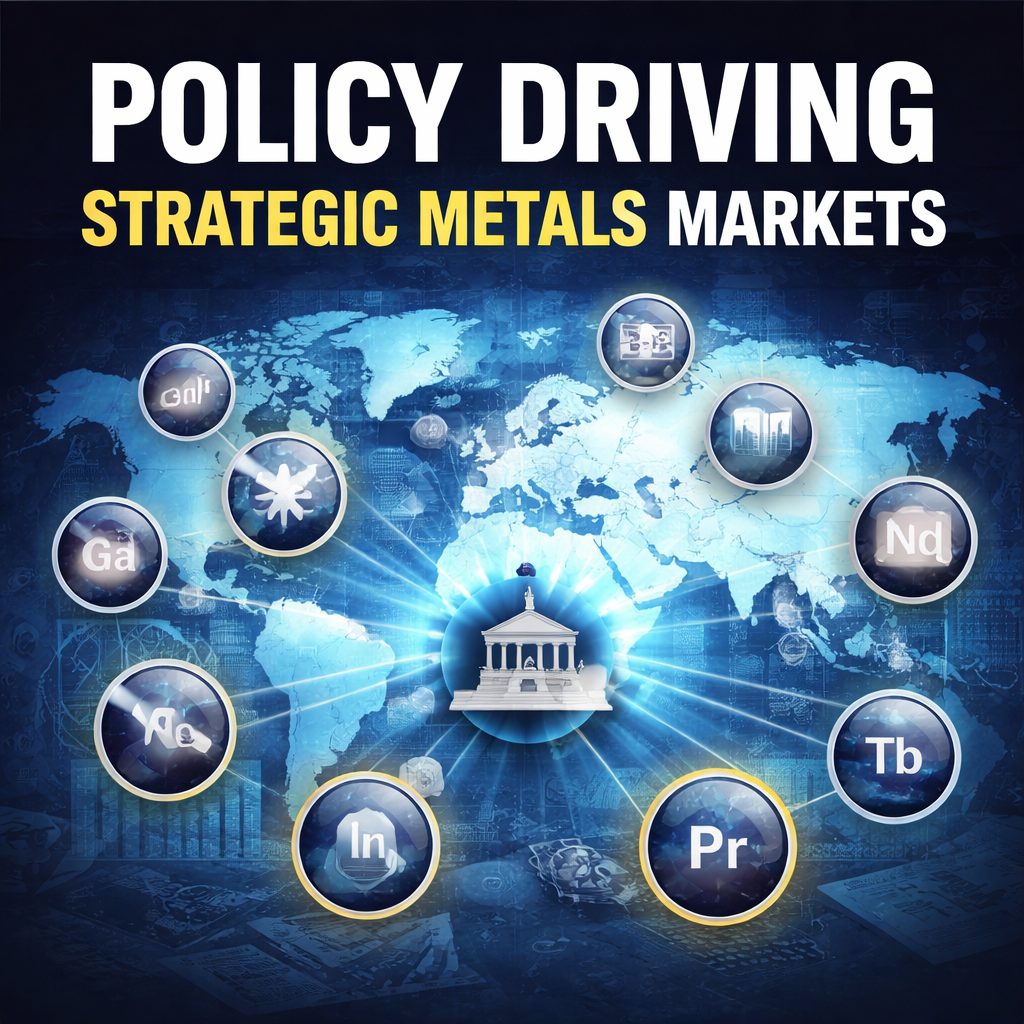
Over the past quarter, the strategic metals story has become harder to ignore.
These markets are no longer shaped solely by visible shortages or sudden spikes in industrial demand. Increasingly, they are being shaped earlier, by policy.
Export controls, stockpiling plans, defence priorities, industrial subsidies, supply agreements, and government-backed processing projects are all starting to influence availability before a supply problem becomes obvious to the wider market.
That matters because, in strategic metals, availability often starts driving the story before price does.
Strategic metals are no longer just a supply-and-demand story
We have written before that strategic metals are not uniform markets. Each metal has its own supply chain, its own industrial role, and its own vulnerabilities.
Dysprosium is not gallium. Hafnium is not indium. Tellurium does not respond to the same pressures as antimony or bismuth.
But across the sector, the broader pattern is becoming clearer. Governments are no longer treating these materials as background commodities. They are treating them as strategic inputs linked to industry, energy systems, defence capabilities, and national resilience.
Once that happens, markets begin to behave differently.
A metal does not need to be in an acute global shortage for buyers to start thinking differently about it. Repricing can begin when access becomes less certain, when alternative supply is difficult to build, or when more countries start competing to secure the same material at once.
That is why this market can still look relatively calm on the surface while changing meaningfully underneath.
Why policy matters more in strategic metals
In larger commodity markets, policy is certainly important, but pricing is often still driven by broader, more visible market forces. Strategic metals are different.
Many of these markets are small, specialised, opaque, and heavily concentrated. Supply chains can depend on a limited number of producers, processors, or jurisdictions. In some cases, refining capacity is even more concentrated than raw material production itself.
That creates a different kind of sensitivity.
When a government tightens export controls, funds domestic refining, builds strategic stockpiles, or classifies a material as critical to national security, it does more than create headlines. It changes expectations around future access.
And in strategic metals, changing expectations around access can be enough to begin changing the market.
In other words, policy is no longer sitting in the background. It is increasingly becoming part of price discovery.
Availability risk often appears before price does
This is one of the more important characteristics of strategic metals, and one that many investors miss at first.
In these markets, price is not always the earliest signal.
The earlier signal is often availability risk.
A material may still look reasonably stable in price terms, yet the underlying conditions may already be tightening. Buyers may be watching export restrictions more closely. Governments may be backing new non-Chinese supply chains. Industrial users may be reassessing procurement strategies. Defence demand may be rising. Refining bottlenecks may be becoming harder to ignore.
By the time those pressures are fully reflected in price, part of the shift may already have taken place.
That does not mean every policy announcement leads directly to a price move. Nor does it mean every strategic metal responds in the same way. But it does mean that these markets increasingly need to be understood through the lens of access, processing, and geopolitical relevance, not just headline pricing.
Why performance diverges from one metal to another
One of the most persistent misconceptions in this space is the idea that strategic metals move together.
They do not.
Even when the broader theme is similar, the underlying drivers can differ sharply from one metal to the next.
Some metals respond primarily to defence demand.
Some are tied more closely to energy transition technologies.
Some are shaped by processing bottlenecks.
Some are especially sensitive to export restrictions.
And some are simply affected by the fact that very little supply exists outside a narrow part of the world.
This is why performance can diverge so sharply even within the same quarter.
It also helps explain why broad narratives often miss the real story. The key question is not whether strategic metals as a category are relevant. The better question is which metals are becoming more relevant, and why.
Strategic metals in 2026: a market being repriced by policy
What has become clearer in 2026 is that the market is not waiting for a full-blown shortage before starting to react.
Policy decisions are already influencing how participants think about supply security, sourcing, and long-term access. And because many strategic metals sit at the intersection of industrial policy, trade strategy, and geopolitical competition, that influence is likely to remain significant.
For private investors, this does not mean every headline should be treated as decisive, and it certainly does not mean every metal will move at once.
It does mean, however, that strategic metals are increasingly being shaped by real-world relevance rather than broad commodity narratives.
And real-world relevance can shift quickly when security, trade, and industrial policy begin to overlap.
Final thought
If the first quarter of 2026 has shown anything so far, it is this:
Strategic metals do not need a full-blown shortage to start moving.
In many cases, policy is already moving the market first.