

Weekly News Review March 2 – March 8 2026
March 8, 2026
Weekly News Review March 9 – March 15 2026
March 15, 2026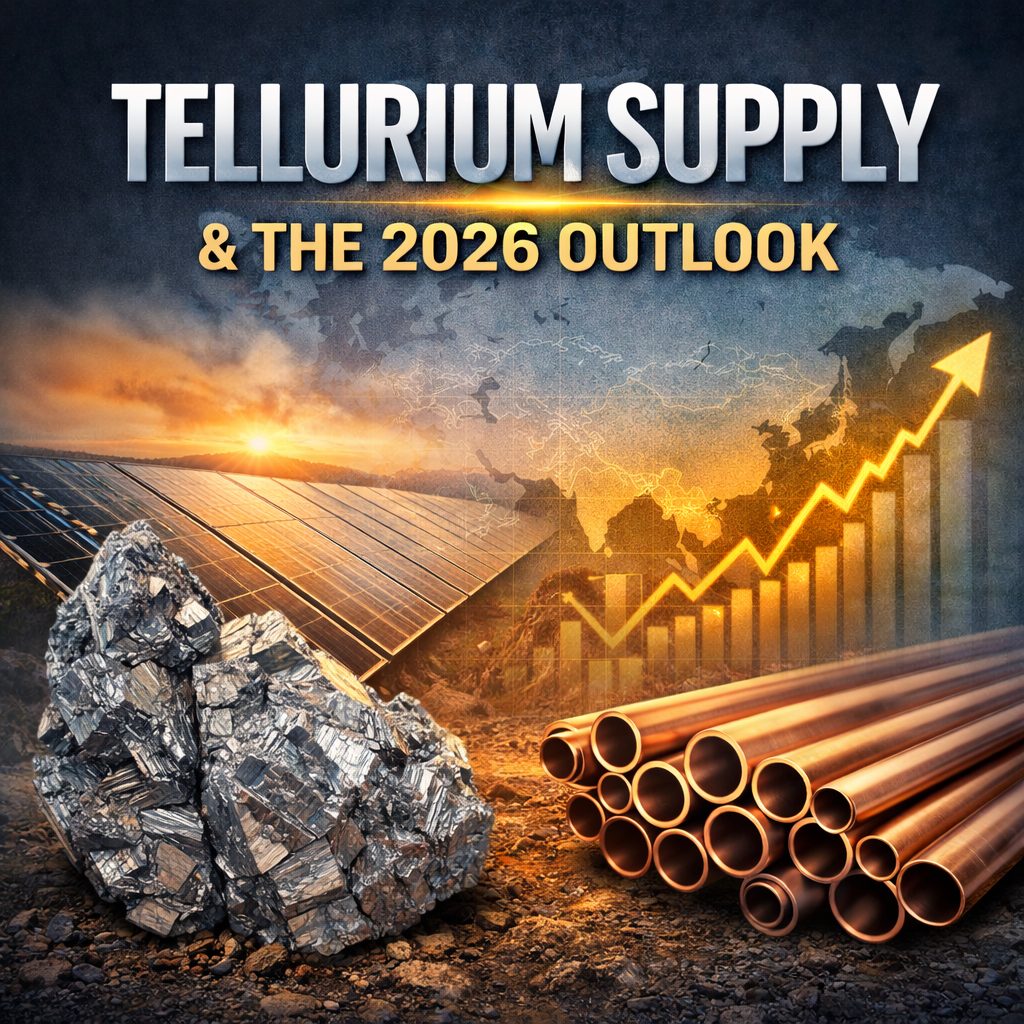
Tellurium is one of the lesser-known strategic metals, yet its role within modern industrial supply chains has become increasingly important.
Demand for tellurium is closely linked to the expansion of solar energy technology, particularly cadmium telluride (CdTe) photovoltaic panels. At the same time, the metal’s supply structure remains constrained because it is produced primarily as a by-product of copper refining.
This combination of growing demand and structurally limited supply makes tellurium a metal worth understanding within the broader strategic metals landscape.
What Is Tellurium?
Tellurium is a rare metalloid element used in a range of industrial and energy-related technologies.
Key uses include:
- Cadmium telluride (CdTe) solar panels
- Thermoelectric devices
- Semiconductor components
- Metallurgical alloys for improved machinability
Among these applications, solar technology has become the most significant driver of demand in recent years.
Because of its unique electronic and thermal properties, tellurium plays a specialised role in several advanced technologies where substitution can be difficult.
Why Tellurium Matters for Solar Energy
One of the largest uses of tellurium today is in cadmium telluride solar panels.
CdTe photovoltaic technology is widely used in large-scale solar farms because it offers several advantages:
- Efficient performance in high temperatures
- Lower manufacturing costs compared with some silicon-based panels
- Strong performance in utility-scale solar installations
As global solar capacity continues to expand, demand for tellurium used in CdTe modules has increased accordingly.
This has elevated tellurium’s profile within discussions around energy transition supply chains.
How Tellurium Is Produced
Unlike many metals that are mined directly, tellurium is generally not mined as a primary product.
Instead, it is recovered during the refining of copper.
During copper smelting and electrolytic refining, small amounts of tellurium accumulate in refinery residues known as anode slimes. These residues are then processed to recover tellurium and other minor elements.
Because of this production method:
- Tellurium supply is linked to copper production levels
- Output cannot easily expand in response to rising tellurium demand
- Recovery capacity depends on specialised refining facilities
This structure keeps the tellurium market relatively small compared with most industrial metals.
Global Tellurium Supply
Global tellurium production remains concentrated among a limited number of countries and refining operations.
Major producing countries include:
- China
- Japan
- Russia
- Canada
Because only a relatively small number of refineries are capable of extracting high-purity tellurium from copper residues, the global supply chain remains narrow.
As with many strategic metals, this concentration makes supply conditions sensitive to industrial policy decisions, refining capacity, and changes in upstream copper production.
Tellurium Market Size
Compared with widely traded base metals, the tellurium market is relatively small.
Annual production is typically measured in hundreds of tonnes rather than thousands or millions.
Small market size means that changes in industrial demand or recovery rates can have a noticeable impact on availability.
For this reason, tellurium is often discussed within the broader category of critical or strategic metals.
The Tellurium Supply Outlook
Tellurium illustrates a structural characteristic shared by several strategic metals: supply is limited not only by geology but by the structure of production.
Because tellurium is produced as a by-product metal, supply growth tends to depend on:
- copper mining activity
- refining technology
- recovery efficiency
Even if demand increases significantly, production cannot expand independently unless copper output or recovery processes increase.
This dynamic means that tellurium availability can remain constrained even as demand from solar technology continues to grow.
Tellurium in the Strategic Metals Landscape
Within the broader strategic metals market, tellurium represents a distinct category.
Some metals are shaped primarily by geopolitics or export controls.
Others are constrained by production structure.
Tellurium falls largely into the second category. Its supply dynamics are closely tied to copper refining and specialised recovery processes.
Understanding these structural factors helps explain why certain strategic metals attract increasing attention as new technologies expand.
👉 Click Here for current pricing data and historical performance
If you would like more info or would like to discuss how tellurium fits within a broader strategic metals allocation, please contact us.