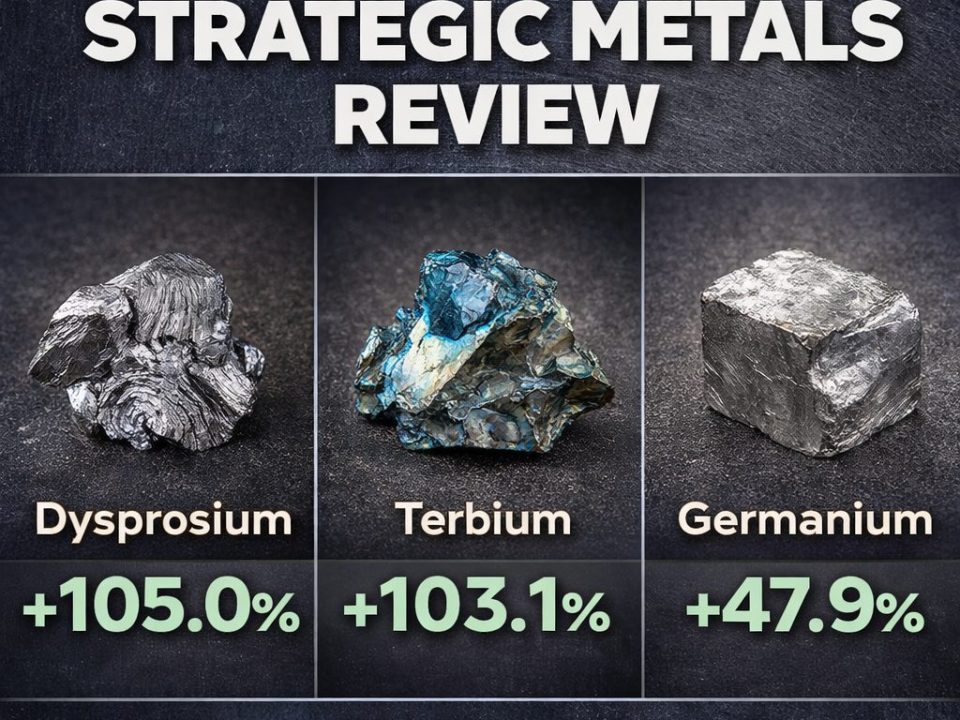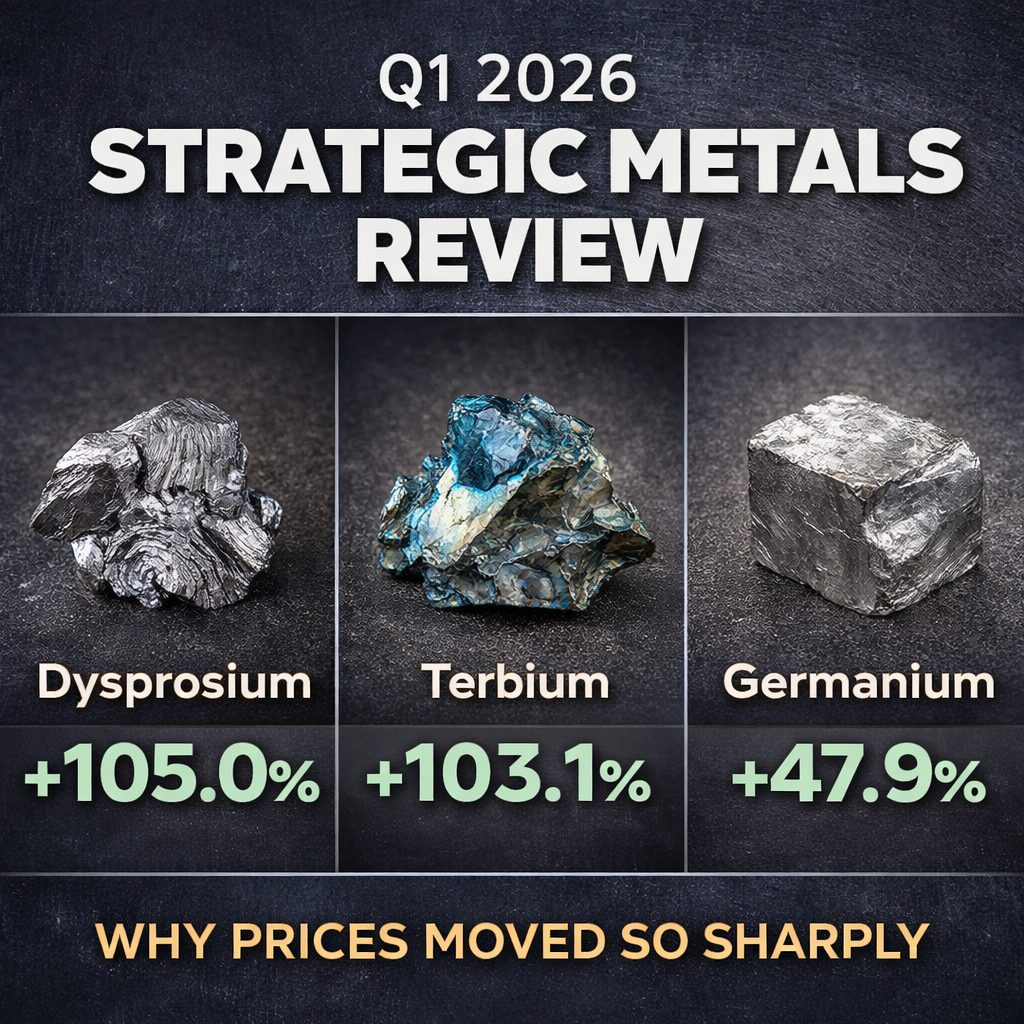
Q1 2026 Strategic Metals Review: Why Prices Moved So Sharply
April 2, 2026
News from the Pacific dominated the critical minerals sphere this week, with Japan accelerating its supply chain diversification after China’s export controls, and Australia moving forward with a strategic minerals reserve. Meanwhile, the Australian mining company Arafura has secured cornerstone funding for its Nolans rare earths project.
AUSTRALIA: ARAFURA LOCKS IN FUNDING FOR NOLANS RARE EARTH PROJECT:
Investments from the German raw materials fund and Export Finance Australia were finalized.
Australian mining company Arafura Rare Earths has secured binding cornerstone equity commitments totaling approximately $159 million (A$230 million), marking a key step toward fully funding its Nolans rare earths project in Australia’s Northern Territory.
The agreements include €50 million (~A$84 million) from Germany’s KfW, acting on behalf of the German Raw Materials Fund, and $100 million (~A$146 million) from Export Finance Australia.
The deals convert earlier non-binding arrangements into firm commitments, lifting Arafura’s total secured funding. Proceeds will support the development of Nolans, which aims to become Australia’s first integrated rare earths mining and processing operation, targeting 4,440 tons per year of neodymium-praseodymium (NdPr) oxide from 2029. This material is a key precursor to the production of rare-earth magnets.
Companies such as Hyundai, Kia, and General Electric have already expressed interest in Arafura’s rare earth products. Additionally, the company has a supply agreement in place with wind turbine manufacturer Siemens Gamesa.
JAPAN ACCELERATES SUPPLY CHAIN DIVERSIFICATION:
Media reports indicate a potential agreement with France and participation in India’s state-backed rare earth magnet program.
At the beginning of the year, China, the world’s leading raw material supplier, tightened export controls on dual-use goods destined for Japan. Officially aimed at the military sector, current export data suggest that the island nation has effectively been cut off from access to several critical minerals since then.
In response, Japan has intensified efforts to diversify its supply chains. This includes participation in a rare earth project in Namibia and a partnership with the Australian mining company Lynas, the largest producer of rare earths outside China. Both initiatives are supported by the Japanese government.
Further steps in this direction are now underway. According to media reports, Japan and France are negotiating a rare-earth agreement. As part of this framework, a joint project to refine heavy rare earths in southwestern France is expected to launch later this year. While no company has been officially named, it likely refers to the project announced last year by the French firm Caremag. Additional initiatives may follow under the bilateral agreement.
A Japanese rare-earth magnet producer may benefit from Indian subsidies.
At the same time, the Japanese company Proterial Ltd. is reportedly considering participation in India’s government incentive program for rare earth magnet production, according to Bloomberg. The company, formerly known as Hitachi Metals, is said to be in discussions with Indian partners. Like many countries, India aims to more effectively develop its own rare earth reserves, with a particular focus on building domestic refining and magnet manufacturing capacity. These downstream segments of the value chain represent critical bottlenecks, as China’s dominance is even more pronounced here than in mining.
Japan has long been regarded as a pioneer in building resilient supply chains. A key role is played by the Japan Organization for Metals and Energy Security (JOGMEC), which provides financial support for resource projects both domestically and abroad.
The decisive impetus for this strategy dates back to 2010, when China effectively halted rare-earth exports to Japan following a diplomatic dispute, highlighting China’s vulnerability to its reliance on imports.
AUSTRALIA CLEARS PATH FOR RARE EARTH RESERVES:
The Australian government is expanding the mandate of Export Finance Australia (EFA), the country’s state-owned export credit agency, to strengthen the domestic economy. In the future, the government will be able to work directly with suppliers via EFA to secure fuel and other strategic goods for households and businesses.
The legislative amendment also lays the groundwork for establishing a strategic reserve of critical minerals, which will be actively managed by EFA. The creation of such stockpiles had already been announced by the government almost a year ago. Initially, the focus will be on antimony, gallium, and rare earth elements, according to Trade Minister Don Farrell. Initial investments are estimated at around $760 million.
FIGURE OF THE WEEK: – 10 GRAMS – THIS IS THE AMOUNT OF MAGNETIC MATERIAL NEEDED PER KILOWATT IN ELECTRIC MOTORS IN 2023 – DOWN FROM 15 IN 2020