
Weekly News Review February 16 – February 22 2026
February 22, 2026
Weekly News Review February 23 – March 1 2026
March 1, 2026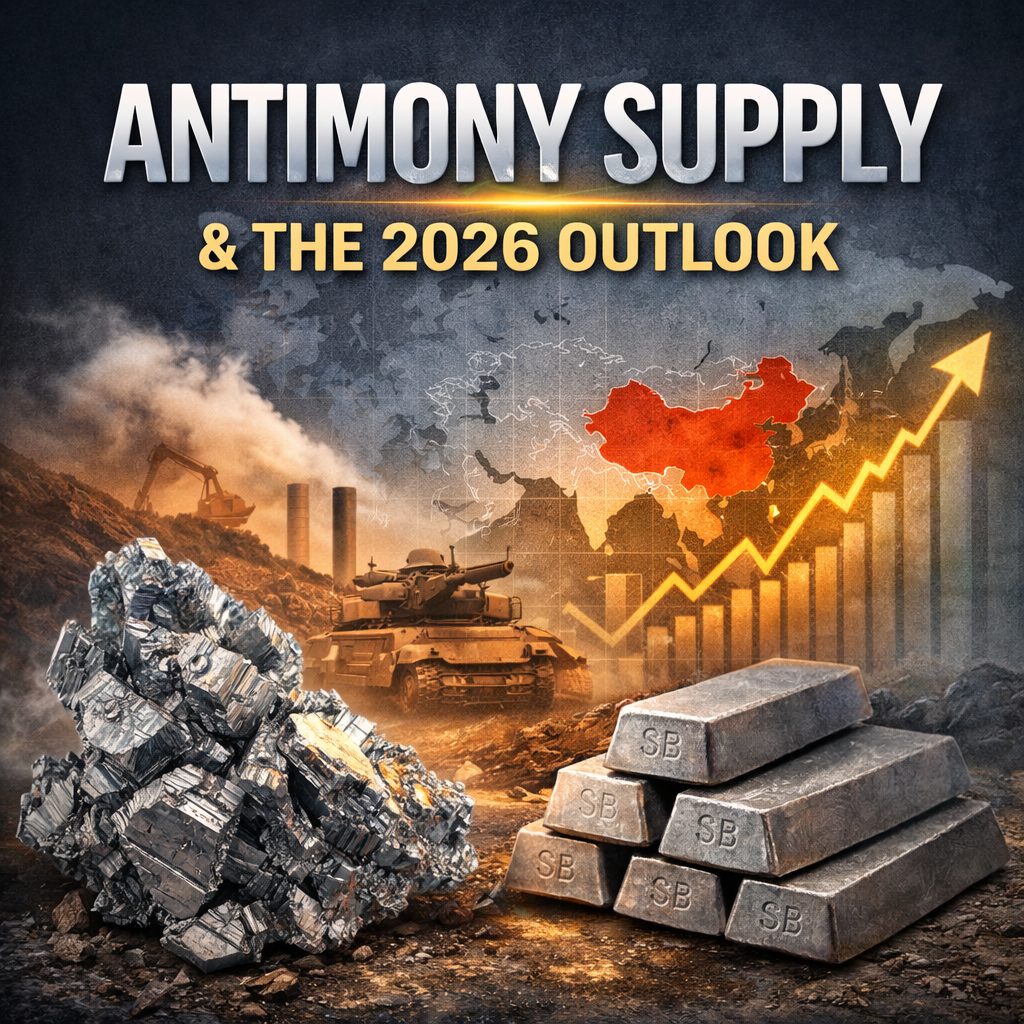
In recent years, strategic metals markets have shifted from purely price-driven cycles to structurally influenced supply dynamics.
Export controls, geopolitical positioning, and defence-related demand are increasingly shaping availability. Antimony offers a particularly clear example of how policy decisions can reshape a relatively small but critical market.
What Is Antimony and Why Is It Strategically Important?
Antimony is a critical industrial metal primarily used in:
- Flame retardants
- Lead-acid battery alloys
- Ammunition and defence applications
- Certain semiconductor and specialty glass uses
Its importance lies in its role as a hardening agent and stabiliser. In many defence and energy-related applications, substitution is technically difficult or economically inefficient.
Antimony sits at the intersection of industrial manufacturing and national security supply chains.
How Concentrated Is Global Antimony Production?
China has historically dominated global antimony refining and processing. In 2025, it remained the leading supplier of refined antimony products.
However, export restrictions introduced in September 2024 significantly altered trade flows. These controls cited national security considerations and the potential military applications of the metal.
Following the restrictions, Chinese antimony exports dropped sharply, and global prices reacted accordingly.
Unlike some other strategic metals, the antimony market has begun to see diversification.
New production sources have emerged in:
- Thailand
- South America
- North America
This gradual expansion has reduced total dependence on a single supplier, though high-purity material production remains concentrated.
How Do Export Controls Affect Antimony?
The September 2024 restrictions marked a turning point.
Exports declined.
Licensing requirements tightened.
Price volatility increased.
At the same time, governments — particularly in the United States — accelerated investment into domestic supply chains. The Pentagon has directly supported antimony-related projects to reduce reliance on foreign sources.
New Chinese export regulations scheduled for implementation in 2026 introduce stricter eligibility requirements for exporters, including creditworthiness and compliance history.
For industrial consumers, this means:
- Regulatory oversight is increasing
- Export predictability cannot be assumed
- Supply chain diversification is becoming policy-driven
Industrial Demand Remains Firm
Antimony demand remains structurally anchored in:
- Energy storage (lead-acid batteries)
- Fire safety standards (flame retardants)
- Defence applications
Unlike highly speculative metals, antimony demand is tied to established industries with stable consumption patterns.
At the same time, geopolitical tensions have elevated its strategic profile.
The 2026 Outlook: Scarcity and Diversification
Antimony presents a different structural pattern compared to some other technology metals.
While supply remains tight, the market is beginning to diversify geographically. New mining and refining projects outside China are gradually reshaping the supply landscape.
However, total global production remains limited, and high-purity processing capacity is still heavily concentrated.
Three defining factors for 2026:
- Export controls remain active.
- Government-backed supply diversification is accelerating.
- Defence-linked demand is structurally embedded.
Antimony is not a speculative story.
It is a policy-sensitive metal with growing strategic attention.
For current pricing data, historical performance, and storage details, visit:
👉 Antimony Price and Price Charts
If you would like more info or would like to discuss how antimony fits within a broader strategic metals allocation, please contact us.