
Weekly News Review October 12 – October 18 2026
October 19, 2026
Weekly News Review October 19 – October 25 2026
October 25, 2026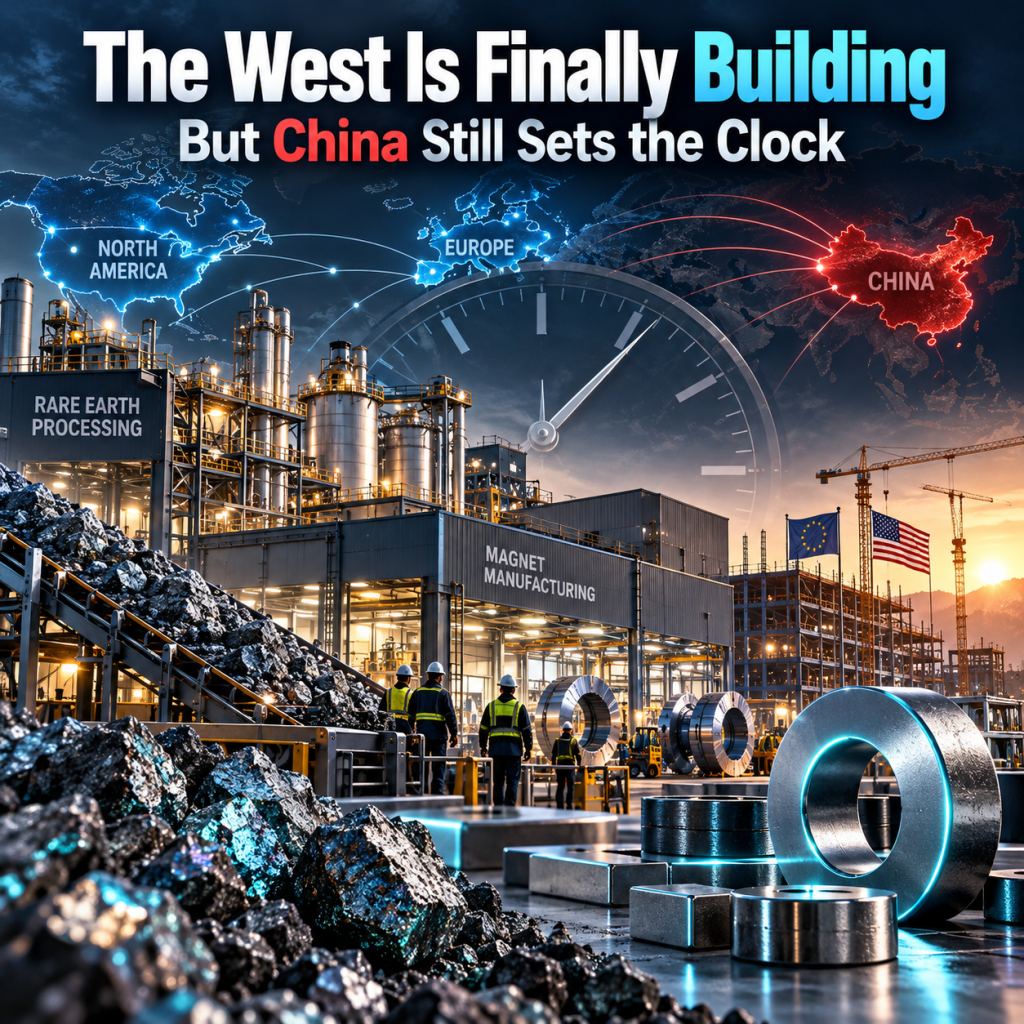
For years, the Western response to China’s dominance of critical minerals consisted largely of reports, strategy documents, funding announcements, and ambitious targets. That is beginning to change.
Mines are advancing. Processing plants are being financed. Rare-earth separation capacity is expanding. And, crucially, permanent magnets are starting to roll off production lines outside China.
That is genuine progress. But there is an important catch: China spent decades building an integrated industrial ecosystem. The West has only recently started trying to recreate it.
The critical-minerals race has therefore entered an interesting new phase. The question is no longer whether the United States, Europe, Australia, and their partners are taking the problem seriously. They clearly are. The question is whether they can build quickly enough.
Europe finally makes a magnet
September brought an important milestone in Estonia.
Neo Performance Materials began commercial production of sintered rare-earth permanent magnets at its new European facility, delivering its first commercial volumes to a Tier 1 electric-vehicle traction-motor customer.
That may sound like another corporate production announcement. It is more significant than that.
Permanent magnets are one of the most important—and most concentrated—links in the rare-earth supply chain. They sit inside electric motors, wind turbines, robotics, industrial equipment, electronics, and defence systems.
The metals may begin the story, but magnets are where much of their industrial value is ultimately realised.
Neo’s facility currently has nameplate capacity of approximately 2,000 tonnes per year. The company is now planning to increase that to around 5,000 tonnes as part of a wider European expansion.
And Europe is helping to fund it.
In October, Neo’s rare-earth separation expansion in Estonia was designated a Strategic Project under the EU Critical Raw Materials Act. Just days later, its wider integrated project was selected for a potential €126 million grant under the EU Innovation Fund, subject to a final grant agreement.
The proposed expansion brings several pieces of the value chain together:
- Rare-earth separation, including both light and heavy rare earths
- Metallisation, converting separated rare-earth oxides into metals
- Permanent magnet manufacturing
- Digital and AI systems designed to improve production efficiency and quality
That integration matters. Europe does not simply need another factory. It needs the chain connecting raw material to finished industrial component.
New York joins the buildout
The same trend is now visible in the United States.
On October 20, Phoenix Tailings announced plans for a commercial-scale rare-earth processing facility in Rochester, New York. Reuters reported an estimated investment of $375 million.
The proposed plant is expected to process more than 18,000 tonnes of rare-earth feedstock annually, producing more than 4,400 tonnes of separated rare-earth oxides at full capacity. Operations are expected to begin ramping up in 2027, with full production planned for 2028.
Again, the important word is not simply “rare earth”. It is processing.
A deposit in the ground does little for a manufacturer if the material still has to travel through a Chinese refinery before it becomes usable.
That is why so much recent government funding has shifted towards the less glamorous middle of the supply chain: separation, refining, metallisation, specialist chemicals, alloys, and magnet manufacturing.
Western policymakers appear to have learned the same lesson industry has been trying to explain for years: the mine is only the beginning.
The numbers show where the bottleneck really is
The International Energy Agency’s 2026 Rare Earth Elements report laid out the challenge particularly clearly.
Outside China, announced projects could increase magnet rare-earth mining capacity to more than 50,000 tonnes of rare-earth content by 2035. But the further you move along the supply chain, the pipeline becomes progressively smaller:
- Mining: more than 50,000 tonnes of potential diversified capacity
- Refining and separation: less than 40,000 tonnes
- Metals, alloys, and finished magnets: only around 18,000 tonnes
These figures are expressed in rare-earth-element content, rather than the total weight of finished magnets.
In other words, the West may eventually become much better at getting rare earths out of the ground than at turning them into something a factory can actually use.
That is the same structural problem we have highlighted throughout this series. A rare-earth mine without separation capacity remains dependent. A separator without metallisation remains dependent. A magnet factory without reliable feedstock remains dependent.
Supply-chain security only exists when the links connect.
China still dominates where it matters most
China’s advantage becomes clearer when you look beyond mining.
According to the IEA’s analysis of the rare-earth supply chain, China accounted for around 60% of global mining of magnet rare earths in 2024.
That is significant, but it is not the most striking number.
- Mining: approximately 60% of global magnet rare-earth output
- Refining: approximately 91% of global refined production
- Sintered permanent magnet manufacturing: approximately 94% of global production
That tells us where the real concentration sits.
China does not merely control a large share of the rocks. It dominates the knowledge, infrastructure, equipment, chemistry, processing capacity, supplier relationships, and downstream manufacturing required to transform those rocks into high-performance components.
That ecosystem has produced enormous economies of scale. It has also created something much harder to replicate than a mine: experience.
You cannot fast-track thirty years of know-how
Money helps. Permitting reform helps. Government grants help. Long-term purchase agreements help.
But some parts of an industrial ecosystem cannot simply be purchased overnight.
Rare-earth separation is technically demanding. Producing metals and alloys to consistent industrial specifications requires specialist knowledge. Magnet manufacturing introduces another layer of intellectual property, equipment, quality control, and customer qualification.
The IEA also highlights major equipment and skills bottlenecks outside China. For certain specialised processes, very few non-Chinese equipment suppliers exist, making machinery significantly more expensive and increasing delivery times, sometimes by several years.
Then there is the workforce.
Engineers, metallurgists, chemists, process specialists, and experienced plant operators need to be trained. Manufacturers need to qualify new material. Customers need confidence that a new supplier can deliver the same specification repeatedly, not just produce an impressive first batch.
That is why announcements should be treated carefully:
- A project announcement is not a factory.
- Construction is not commissioning.
- Commissioning is not commercial production.
- And commercial production is not yet an industrial ecosystem.
That does not mean diversification is failing
It would be equally wrong to look at China’s dominance and conclude that nothing is changing.
A lot is changing.
Europe now has commercial rare-earth magnet production in Estonia. Heavy rare-earth separation capacity outside China is expanding. Australia, the United States, Brazil, Canada, and other countries are advancing new mining and processing projects.
Governments are also using tools that would have seemed extraordinary in commodity markets only a few years ago:
- Direct equity investments
- Low-cost financing
- Grants and tax incentives
- Minimum-price arrangements
- Long-term offtake agreements
- Defence procurement
- Strategic stockpiling
The objective is no longer simply to find alternative minerals. It is to make alternative supply chains commercially viable.
That is a much more serious undertaking.
Security of supply now carries a price
Another important change is taking place among industrial buyers.
For decades, procurement departments were rewarded for efficiency and low cost. If the cheapest qualified material came from China, buying it made perfect commercial sense.
Geopolitics has altered that calculation.
The cheapest material is not necessarily the cheapest option if its absence can stop a factory.
Companies in the United States and Japan have increasingly shown a willingness to pay more for secure non-Chinese supply. Europe has been somewhat more price-sensitive, but the broader trend is clear: security of supply is developing an economic value of its own.
The IEA’s research also describes the premium paid for magnets produced outside China, reflecting the growing role of supply security in purchasing decisions.
It is essentially insurance.
A manufacturer may willingly pay more for diversified supply if the alternative is exposure to a single country, unpredictable export licences, and the possibility of production stopping altogether.
For small strategic-metal markets, that represents a profound change.
Small metals, enormous consequences
One of the peculiarities of strategic metals is the mismatch between the size of the raw-material market and the value of the industries depending on it.
Rare earths are used in relatively small physical quantities. Gallium production is tiny compared with aluminium. Germanium is barely a rounding error next to zinc. Rhenium and hafnium are produced in volumes that would be insignificant in most commodity markets.
Yet those small quantities can determine whether much more valuable products can be manufactured at all.
The IEA estimates that full implementation of China’s wider rare-earth export controls could put around $6.5 trillion of annual downstream production outside China at risk.
That is an extraordinary ratio. Tiny volumes of material sit underneath trillions of dollars of industrial output.
This is why governments are becoming involved. And it is why manufacturers are becoming much less casual about where their materials come from.
What this means for strategic-metal investors
For private investors, the lesson is not that China’s dominance will last forever. Nor is it that every Western project will succeed.
The important point is that diversification itself confirms the strategic relevance of these materials.
Companies and governments are spending billions because they have concluded that dependence on highly concentrated supply chains carries economic and national-security risk.
New capacity will eventually improve supply, assuming projects are successfully completed and commercially viable. That is both necessary and desirable.
But building meaningful alternative production in strategic metals is a medium- to long-term process. It requires far more than finding deposits and raising capital. It requires processing technology, equipment, expertise, qualified customers, reliable feedstock, infrastructure, and time.
That is why strategic metals themselves are best viewed through the same lens: not as short-term trades, but as physical assets exposed to long-term industrial trends and structural supply constraints. Prices can still be volatile, and industrial resale depends on market conditions and availability of buyers.
The bottom line
The West is finally building. That matters.
Europe now has commercial rare-earth magnet production. New processing facilities are moving forward in the United States. Governments are funding separation, refining, magnet manufacturing, and recycling. Alternative supply chains are becoming physical rather than theoretical.
But China still sets much of the clock.
It built its ecosystem over decades. Its dominance is greatest precisely in the stages that are hardest to reproduce: refining, separation, metallisation, specialist manufacturing, and permanent magnets.
The gap could narrow substantially as new projects enter production, but it will not disappear simply because a new mine opens or a government announces another billion-dollar programme.
The strategic-metals race is increasingly about who can build the complete industrial chain—and how long that takes.
For investors, that is perhaps the most important part of the story.
Interested in adding physical strategic metals to your portfolio? Contact us to arrange a call and learn more about the metals currently available to private investors, how ownership works, and the risks and practical considerations involved.