



Weekly News Review July 13 – July 19 2026
July 19, 2026
Weekly News Review July 20 – July 26 2026
July 26, 2026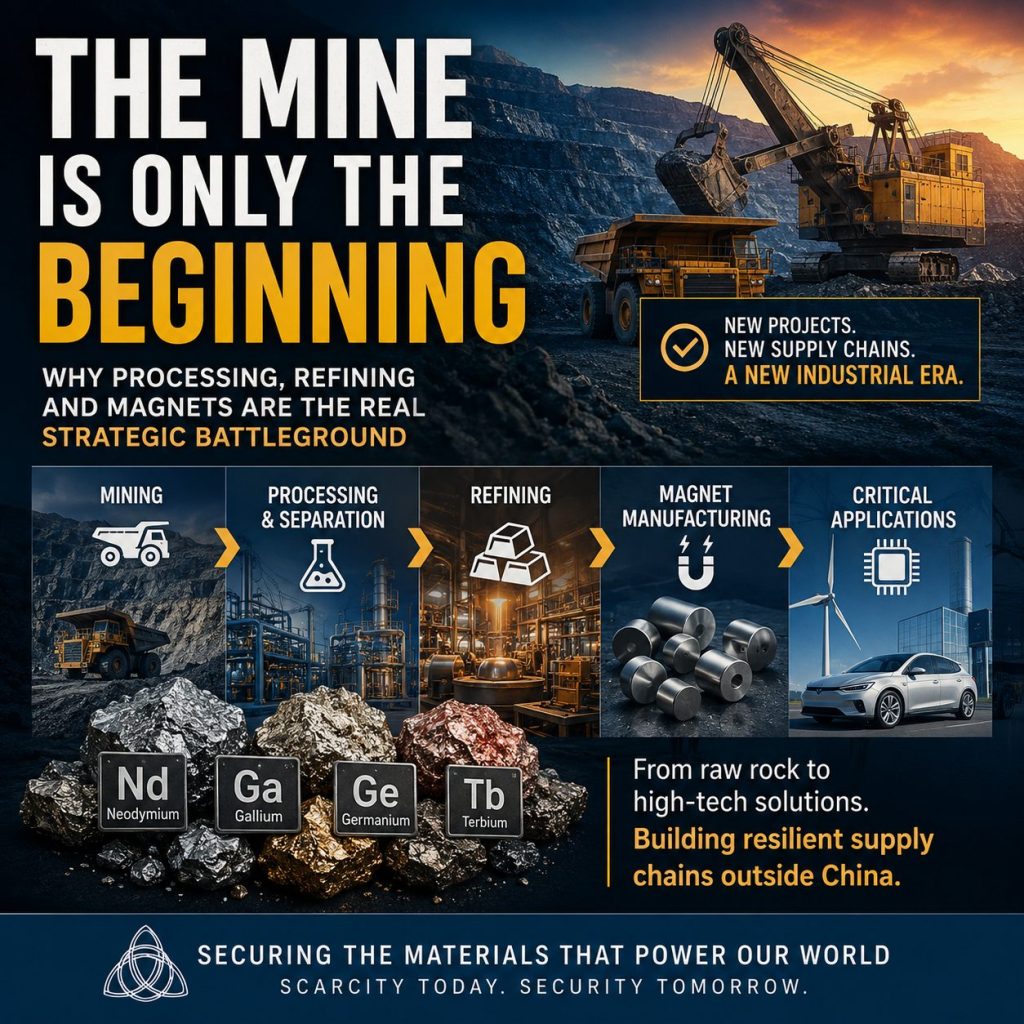
For years, Western governments have responded to critical-mineral insecurity with a reassuringly simple solution:
Open more mines.
It sounds logical. If China controls too much of the supply, dig somewhere else. Australia has minerals. Canada has minerals. The United States has minerals. Greenland appears in the conversation whenever politicians require something large, frozen, and strategically dramatic.
Problem solved.
Except it isn’t.
A strategic metal sitting underground is not yet useful to a semiconductor manufacturer, aircraft engine producer, wind-turbine company, or electric-vehicle factory. Before industry can use it, the material must be extracted, concentrated, separated, refined, processed to exact specifications, transported, qualified, and sometimes converted into components such as permanent magnets.
That is not a supply chain.
It is an industrial obstacle course.
And China built most of the course while the West was admiring the view from the starting line.
The missing middle
The phrase “mine to magnet” is appearing increasingly often in critical-minerals announcements.
There is a good reason for that.
Mining gets the attention because it is visible. There are excavators, enormous holes in the ground, geological surveys, politicians in hard hats, and photographs that look suitably industrious.
Processing is less glamorous.
It involves chemical separation, refining equipment, technical expertise, environmental controls, specialised facilities, customer qualification, and years of painstaking industrial development.
Unfortunately, processing is also where much of the strategic power sits.
Rare-earth ore, for example, does not emerge from the ground conveniently separated into neat containers of neodymium, praseodymium, dysprosium, and terbium. These elements occur together and must be separated through complex processes before manufacturers can use them.
Even then, producing rare-earth oxides is not the same as manufacturing high-performance permanent magnets.
A mine can provide the raw material.
A magnet factory provides the component that an electric motor, wind turbine, robot, drone, or defence system can actually use.
That distinction has finally started to shape industrial policy.
July’s critical-minerals building programme
Several developments during July show that governments and companies are beginning to move beyond mining announcements.
The first came from Lynas Rare Earths and South Korea’s JS Link.
The companies signed a long-term agreement to establish a rare-earth permanent magnet manufacturing facility near Lynas’ advanced materials plant in Kuantan, Malaysia. The proposed plant is expected to produce up to 3,000 tonnes of neodymium-iron-boron permanent magnets annually.
Lynas plans to invest approximately A$50 million in JS Link, while also supplying rare-earth materials to the company’s facilities in Malaysia and South Korea under a long-term arrangement extending into 2038.
This matters because it connects several parts of the supply chain.
Lynas already mines rare earths in Australia and processes them in Australia and Malaysia. JS Link brings magnet-manufacturing expertise. Putting the two together creates something more meaningful than another mining project: a pathway from mineral concentrate to a finished industrial component.
The magnet, after all, is what the manufacturer needs.
Nobody builds an electric motor around a promising geological deposit.
Gallium moves from proposal to production plan
A second important development came from Western Australia.
Alcoa, together with partners and the governments of Australia, Japan, and the United States, reached a final investment decision on a gallium production plant at its Wagerup alumina refinery.
The project demonstrates one of the defining features of strategic-metal supply.
Gallium is not normally mined from a dedicated gallium deposit. It is primarily recovered as a by-product of aluminium production. That means producing more gallium is not simply a matter of finding a gallium mine and increasing output.
The recovery process must be integrated into an existing industrial operation.
Alcoa intends to use its alumina-refining infrastructure and mineral-processing expertise to create a new non-Chinese source of the metal. The project is targeting annual production of approximately 100 tonnes by 2028–2029—equivalent to around 10% of current global demand.
That would be a meaningful addition to a small and strategically important market.
Gallium is used in compound semiconductors, power electronics, radio-frequency components, LEDs, satellite systems, advanced communications, and defence technologies.
Its importance has become much harder to ignore since China introduced export controls in 2023 and later prohibited direct exports to the United States before subsequently suspending that specific ban.
The Wagerup project is therefore more than a new production facility.
It represents three allied governments collectively acknowledging that access to a small, silvery by-product has become a matter of industrial and national security.
Gallium may melt in your hand.
Its supply chain is considerably harder to soften.
Canada targets the refinery, not just the rock
Canada has also moved further into the processing end of the supply chain.
On July 7, the Canadian government launched its Critical Minerals Accelerator and announced its first strategic investment agreement with the Canada Growth Fund and Teck Resources.
The agreement supports expanding critical-minerals production at Teck’s Trail Operations in British Columbia, one of the world’s largest integrated smelting and refining complexes.
Trail is also home to Canada’s only germanium-producing smelter.
Germanium is another metal that demonstrates why “just mine more” is inadequate advice. It is mainly recovered as a by-product of zinc processing and, to a lesser extent, from coal fly ash.
Its availability is therefore tied to other industrial processes.
Germanium is essential for fibre-optic communications, infrared optics, thermal imaging, specialised electronics, solar applications, and defence systems. Yet expanding production requires far more than geological resources. It requires an operating smelter with the knowledge and equipment to recover and refine relatively small quantities of material to exacting standards.
Canada’s new programme is designed to support projects across the value chain, from extraction through processing.
That final phrase—“through processing”—may be the most important part.
North America searches for its magnet link
The same week, REalloys and JS Link announced a strategic letter of intent to explore an integrated North American rare-earth magnet platform.
REalloys is developing mining, processing, and separation capabilities. JS Link brings permanent-magnet manufacturing expertise and has already announced plans for a major magnet facility in Georgia.
Again, the strategic logic lies in connecting the links.
A rare-earth mine without separation capacity remains dependent on someone else’s refinery.
A refinery without magnet manufacturing still sends material further down a supply chain that may remain exposed.
A magnet plant without secure feedstock has built a factory around a question mark.
The goal is therefore no longer merely to establish isolated projects outside China. It is to build connected systems that can take material from the ground, process it, transform it into an industrial product, and deliver it to a manufacturer.
That is what supply-chain independence actually looks like.
It is less like opening a mine and more like recreating an ecosystem.
China’s advantage took decades to build
This is also why replacing Chinese supply will be difficult.
China’s position was not created by geology alone. It was built through decades of investment in refining capacity, technical knowledge, specialist equipment, industrial relationships, infrastructure, and downstream manufacturing.
Its advantage is cumulative.
A processing facility benefits from experienced workers. Equipment suppliers improve through repeated use. Customers become comfortable with established specifications. Manufacturers design production processes around familiar materials. Logistics networks become efficient. Waste-handling systems develop. Financing becomes easier because the industrial ecosystem already exists.
Creating a competing supply chain means reproducing much of that expertise elsewhere.
And doing so under stricter environmental rules, higher labour costs, lengthier permitting systems, and intense political scrutiny.
Recent challenges faced by non-Chinese producers illustrate how difficult this can be. Specialised equipment is expensive. Achieving the purity and consistency demanded by industrial customers is technically demanding. Sourcing equipment and expertise without relying on China can add further cost and delay.
The West is not merely trying to open new facilities.
It is trying to compress several decades of industrial development into a few politically urgent years.
That will not be cheap.
It will not be quick.
And it probably will not proceed in a straight line.
The by-product problem
Several strategic metals share another awkward characteristic: they are not produced independently.
Gallium is primarily recovered from aluminium refining.
Germanium is commonly recovered from zinc processing.
Hafnium is produced during the refining of zirconium.
Rhenium is recovered mainly from molybdenum concentrates associated with copper mining.
Indium is produced largely as a by-product of zinc.
This means supply cannot always respond directly to demand.
A dramatic increase in demand for rhenium does not automatically justify mining more copper. Higher demand for hafnium does not necessarily result in more zirconium refining. A semiconductor boom cannot simply instruct aluminium refineries to recover gallium if the required systems do not exist.
The host industry must be operating.
The material must be present in recoverable concentrations.
The recovery process must be technically and economically viable.
The refining capacity must exist.
And somebody must be willing to invest before a shortage becomes a crisis.
This creates a supply structure that is naturally slow to adjust.
It also explains why relatively small changes in availability can have an outsized effect on strategic-metal markets.
Governments become industrial partners
Another clear shift is the growing role of governments.
The Alcoa gallium project is supported by Australia, Japan, and the United States.
Canada’s government is investing alongside industry through its new Critical Minerals Accelerator.
The United States has used funding, procurement agreements, equity investments, and strategic partnerships to encourage domestic and allied production.
These interventions would have seemed unusual in many commodity markets not long ago.
They are becoming normal in critical minerals.
The reason is straightforward: commercial markets alone may not build secure alternative supply chains quickly enough.
Producing metals outside China can be more expensive. New facilities face high initial costs. Small markets can make investment risky. A sudden increase in production could even create temporary oversupply, undermining the very Western producer governments are trying to establish.
Public support helps absorb some of that risk.
It can also provide the long-term certainty needed to finance processing facilities whose strategic importance exceeds their immediate commercial appeal.
This is industrial policy returning through the loading dock.
What this tells private investors
For private investors, these developments reinforce an important point.
The scarcity of strategic metals is not purely geological.
It is also industrial.
A metal can exist in the Earth’s crust and still remain difficult to obtain. The constraint may be recovery, refining, separation, technical expertise, permitting, equipment, transport, qualification, or political access.
This is why strategic metals must be assessed individually.
Each one has its own supply chain, production method, industrial applications, substitution risks, and geopolitical exposure. There is no single “critical minerals market” moving neatly in one direction.
There are many small and specialised markets, each responding differently to physical events.
New Western capacity will eventually improve supply security. That is the objective, and it is good for industry.
But these projects also reveal how difficult, expensive, and time-consuming diversification will be.
A final investment decision is not production.
Construction is not qualification.
A refinery is not a magnet factory.
And a mine is only the beginning.
Strategic metals are therefore most sensibly approached as medium- to long-term physical assets. They are not suited to rapid trading or simplistic predictions based on a single headline.
Their relevance lies in the long-term tension between industrial necessity and supply chains that cannot be expanded quickly.
The bottom line
The response to China’s critical-minerals dominance is becoming more concrete.
Magnets are planned in Malaysia and North America.
Gallium production is advancing in Australia.
Germanium capacity is receiving support in Canada.
Governments are no longer limiting themselves to publishing critical-minerals lists and admiring the seriousness of the problem.
They are beginning to build.
That is significant progress.
It is also a reminder of the scale of the task.
The modern economy does not run on ore. It runs on refined materials, specialised components, reliable specifications, qualified suppliers, and functioning industrial networks.
Building a mine may take years.
Building the ecosystem around it can take decades.
At Strategic Metals Invest, we provide private investors with access to selected physical rare earths and technology metals through established industrial supply chains, professional storage, and a structured route back to industrial buyers.
Because when the world begins spending billions to secure a material, it is worth understanding why that material was difficult to obtain in the first place.