
Weekly News Review August 24 – August 30 2026
August 30, 2026
Weekly News Review August 31 – September 6 2026
September 6, 2026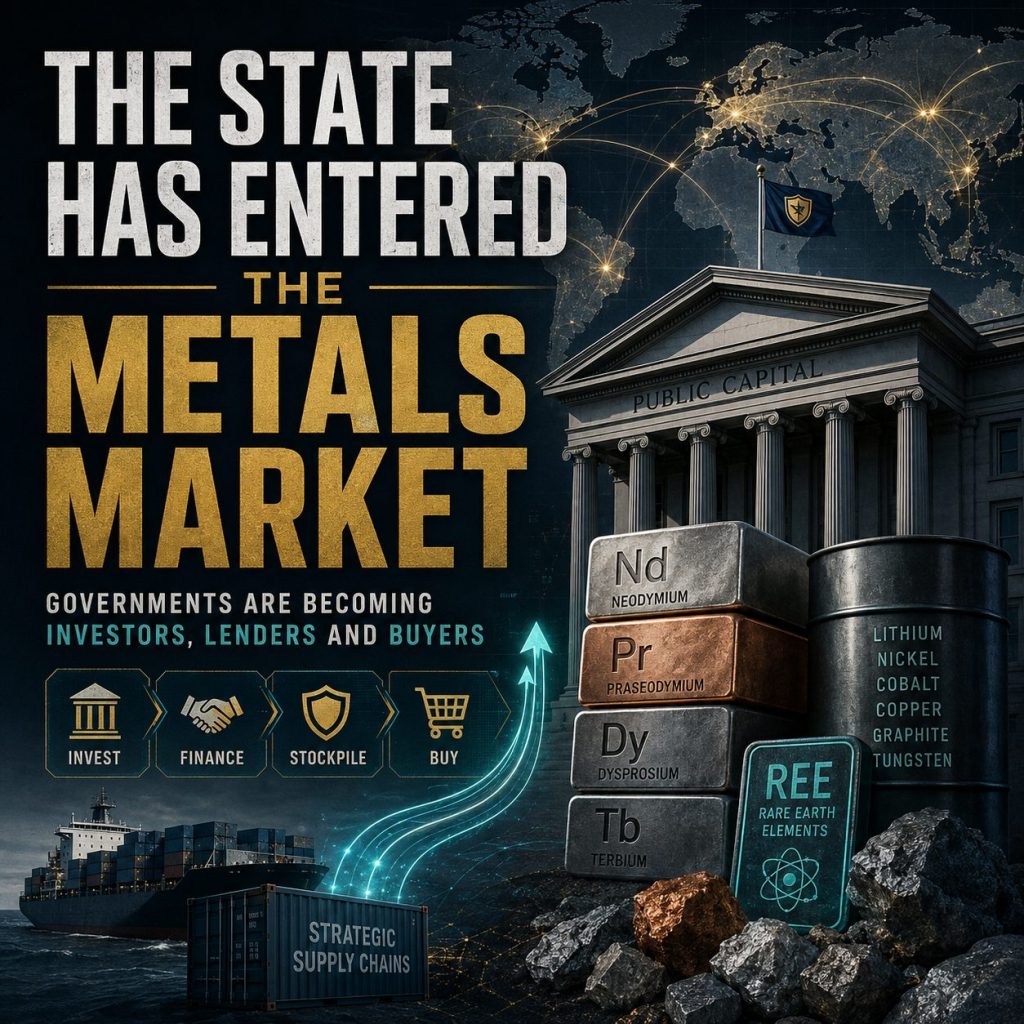
There was a time when governments dealt with critical minerals in the traditional way.
- They commissioned studies.
- They published lists.
- They held conferences.
- They issued statements expressing deep concern about supply-chain resilience and then, presumably satisfied that everyone was sufficiently concerned, went home.
Those days appear to be ending.
Governments are increasingly doing something much more interesting.
- They are writing cheques.
- They are taking equity stakes in mining companies. They are financing processing plants. They are guaranteeing purchases. They are supporting minimum prices.
- They are building stockpiles. And in some cases, they are becoming the customer.
That represents an important change in the strategic-metals market.
The most interesting signal today may not be what appears on a price chart.
It may be who is prepared to guarantee the buyer.
Brazil provides the clearest example yet
Late August brought perhaps the most striking example.
The United States announced a $750 million government investment supporting an offtake structure for rare-earth material produced by Serra Verde at its Pela Ema operation in Brazil.
But the headline figure tells only part of the story.
The wider structure totals $1.55 billion.
Alongside the $750 million government commitment is up to $500 million in bank financing and a commitment by the U.S. Defense Logistics Agency to purchase at least $300 million of rare-earth products over five years.
In other words, this is not simply a subsidy to help someone dig a hole.
It is an attempt to construct an entire commercial bridge between a mine in Brazil and strategic demand in the United States.
And the metals involved should sound familiar:
- Neodymium.
- Praseodymium.
- Dysprosium.
- Terbium.
The four rare earths at the heart of high-performance permanent magnet supply chains.
Serra Verde is particularly significant because its Pela Ema project produces all four magnetic rare earths commercially outside Asia.
That makes it unusual.
And apparently valuable enough strategically for Washington to help ensure that its future production already has somewhere to go.
Meet the government-backed customer
The structure is worth examining because it illustrates how critical-mineral policy is evolving.
Traditionally, a mining company develops a project, produces material, and then attempts to sell it into the market.
The risk belongs largely to the producer.
Will there be a buyer?
At what price?
Will enough customers commit to justify expanding production?
Those questions become particularly difficult in small strategic-metal markets.
A new Western producer may face higher costs than an established Chinese supplier. It may need to spend heavily on processing infrastructure. It may be entering a market where annual global production is tiny compared with copper, iron ore or aluminium.
And there is a rather awkward problem.
If the West successfully creates a lot of new supply at once, it can temporarily depress market prices and make the new Western projects uneconomic.
China, with established infrastructure and lower costs, can often tolerate that environment better.
So governments are beginning to change the equation.
Instead of merely telling companies, “Please build us a secure supply chain”, they are increasingly saying:
“We will help finance it, and we may help provide the customer too.”
That is a very different proposition.
From regulator to shareholder
Four days after the Serra Verde announcement came another example.
The U.S. government announced a $35.6 million strategic equity investment in Trilogy Metals, supporting the Upper Kobuk Mineral Projects in northwest Alaska.
The investment gives the government a direct ownership stake, plus warrants, in a project containing copper, cobalt, germanium and other critical minerals.
Germanium is particularly interesting from our perspective.
It is essential for fibre-optic communications, infrared optics, specialised electronics, semiconductors and defence technologies.
It is also precisely the kind of strategic metal that illustrates the vulnerability of modern supply chains.
Germanium is generally not mined independently. It is recovered primarily as a by-product of zinc processing and from certain other industrial feedstocks.
You cannot simply decide the world needs more germanium and open a germanium mine next Tuesday.
The material has to exist in recoverable concentrations within another production stream. Recovery infrastructure must then be built, and the material must be refined to the purity required by industry.
The government’s Trilogy investment therefore reinforces something we discussed in our previous article, The Mine Is Only the Beginning.
Access to strategic metals depends on much more than geology.
And governments increasingly appear willing to own part of the solution.
Even alumina has become strategic
On the same day as the Trilogy announcement, another $100 million U.S. government equity investment was announced in Atlantic Alumina Company, or Atalco.
That brings government investment in the company to $400 million.
Combined with private capital, the current investment programme totals around $800 million.
Why?
Because Atalco operates the last remaining domestic alumina refinery in the United States.
Alumina is hardly an obscure strategic metal. It is the intermediate material used to produce aluminium.
But this is precisely why the development matters.
Critical-mineral policy is broadening from individual exotic metals towards the entire industrial system required to manufacture advanced products.
A fighter aircraft does not care whether its supply-chain problem involves a rare earth, an obscure technology metal or a familiar industrial material.
If the missing component stops production, it is strategic.
The definition is increasingly being determined by vulnerability rather than novelty.
Half a billion dollars for the middle of the chain
The U.S. Department of Energy added another piece to the picture in August.
It selected seven projects for a combined $500 million aimed at expanding domestic critical-material processing, battery manufacturing and recycling capacity.
Notice the emphasis.
- Processing.
- Manufacturing.
- Recycling.
This is not simply a mining programme.
It reflects growing recognition of the same “missing middle” we discussed in our previous newsletter.
Owning mineral resources underground does not create supply-chain independence if those resources still need to be shipped elsewhere for processing.
A mine without a refinery can remain dependent.
A refinery without specialist manufacturing can remain dependent.
A magnet factory without secure rare-earth feedstock can remain dependent.
What governments are now trying to create is not a collection of mines.
It is an ecosystem.
Governments discover the offtake agreement
Perhaps the least glamorous but most important phrase in the entire critical-minerals story is becoming:
Long-term offtake agreement.
An offtake agreement is essentially a commitment by a buyer to purchase future production.
For a producer, that commitment provides visibility.
For a lender, it reduces risk.
For a government, it provides a mechanism for securing material without necessarily owning and operating the mine itself.
And for strategic metals, where markets can be small and opaque, that certainty can make the difference between a project remaining an attractive PowerPoint presentation and becoming an operating business.
We are therefore seeing governments use several tools simultaneously:
- Equity.
- Loans.
- Purchase guarantees.
- Offtake agreements.
- Price support.
- Strategic stockpiling.
- Direct procurement.
The objective is not simply to encourage more production.
It is to make alternative supply commercially viable.
Why normal market economics sometimes struggle
This raises an interesting question.
If these materials are so important, why doesn’t the private market simply solve the problem itself?
Because strategic-metal markets can be economically awkward.
Take a hypothetical material with annual global production measured in tens or hundreds of tonnes.
Building a new refinery could cost hundreds of millions of dollars.
The project must compete with an established supplier operating at enormous scale.
Customers may want diversification but may be reluctant to pay substantially more for it.
And the moment several competing projects succeed, increased supply may reduce the price.
From a purely commercial perspective, waiting can sometimes look safer than investing.
From a national-security perspective, waiting can look reckless.
That is where the state enters.
Governments are effectively beginning to assign an economic value to something traditional commodity markets do not always price adequately:
security of supply.
The cheapest tonne is not necessarily the most valuable tonne if it disappears when geopolitical relations deteriorate.
China changed the calculation
None of this is happening in a vacuum.
China’s use of export controls on gallium, germanium, rare earths and other critical materials demonstrated that control of processing capacity can become geopolitical leverage.
Western governments received the message.
The response is no longer limited to trying to persuade China to keep supply chains open.
It increasingly involves creating alternative ones.
That transition will take years.
China’s dominance was built over decades through investment, expertise, infrastructure, favourable industrial policy and close integration between mining, refining and manufacturing.
Replacing that ecosystem cannot be achieved with one new mine or one government grant.
But the direction of travel has become unmistakable.
Capital is now being mobilised not merely because critical minerals might become more important someday.
It is being deployed because governments have concluded that access to them is already strategically important today.
The investor lesson is not “follow the government”
There is an important distinction here.
Government investment does not guarantee commercial success.
- A project can still fail.
- New supply can alter market dynamics.
- Technology can change.
- Substitution can reduce demand.
- Government policy itself can change.
The fact that Washington, Brussels, Canberra or another government considers a mineral strategically important does not automatically make that mineral a successful private investment.
That would be far too simple.
But government behaviour does provide information.
When states are willing to become shareholders, lenders and long-term customers in order to secure relatively small quantities of particular materials, it tells us something about how those materials are being viewed inside defence and industrial planning.
Their significance is no longer theoretical.
It is being assigned capital.
Strategic metals become infrastructure
This brings us to the larger theme running through this series.
Strategic metals are increasingly being treated less like ordinary commodities and more like infrastructure.
Countries do not leave their electricity grids entirely to chance.
- They maintain fuel reserves.
- They protect communications networks.
- They secure defence production.
And now they are beginning to apply similar thinking to the physical materials underlying advanced manufacturing.
- Rare earths for permanent magnets.
- Gallium and germanium for semiconductors and communications.
- Rhenium and hafnium for aerospace and high-temperature applications.
- Antimony for defence and industrial uses.
- Tellurium for energy technologies.
These are tiny markets compared with oil.
But modern economies do not need millions of tonnes of a material before its absence becomes a problem.
Sometimes a few kilograms in the wrong place can stop a very expensive production line.
The bottom line
Something fundamental is changing in the critical-minerals market.
Governments are no longer standing on the sidelines asking private industry to solve strategic dependency on its own.
They are stepping onto the field.
The United States is investing directly in companies and projects.
- It is helping finance processing.
- It is guaranteeing purchases.
- It is supporting downstream manufacturing.
- It is committing public capital to supply chains stretching from Brazil to Alaska and back into American factories.
Other countries are pursuing their own versions of the same strategy.
The critical-minerals race has therefore entered a new phase.
- First governments identified the problem.
- Then they introduced policy.
- Now they are deploying capital.
For investors interested in strategic metals, that may be one of the most important developments to watch.
Not because government spending guarantees higher prices.
It doesn’t.
But because governments rarely become customers, financiers and shareholders in obscure raw-material markets unless they believe something important is at stake.
At Strategic Metals Invest, we focus on selected physical rare earths and technology metals whose relevance is rooted in industrial necessity, constrained supply chains and long-term strategic importance.
The world is increasingly treating these materials as infrastructure.
Private investors may want to understand why.