
Weekly News Review October 26 – November 1 2026
November 1, 2026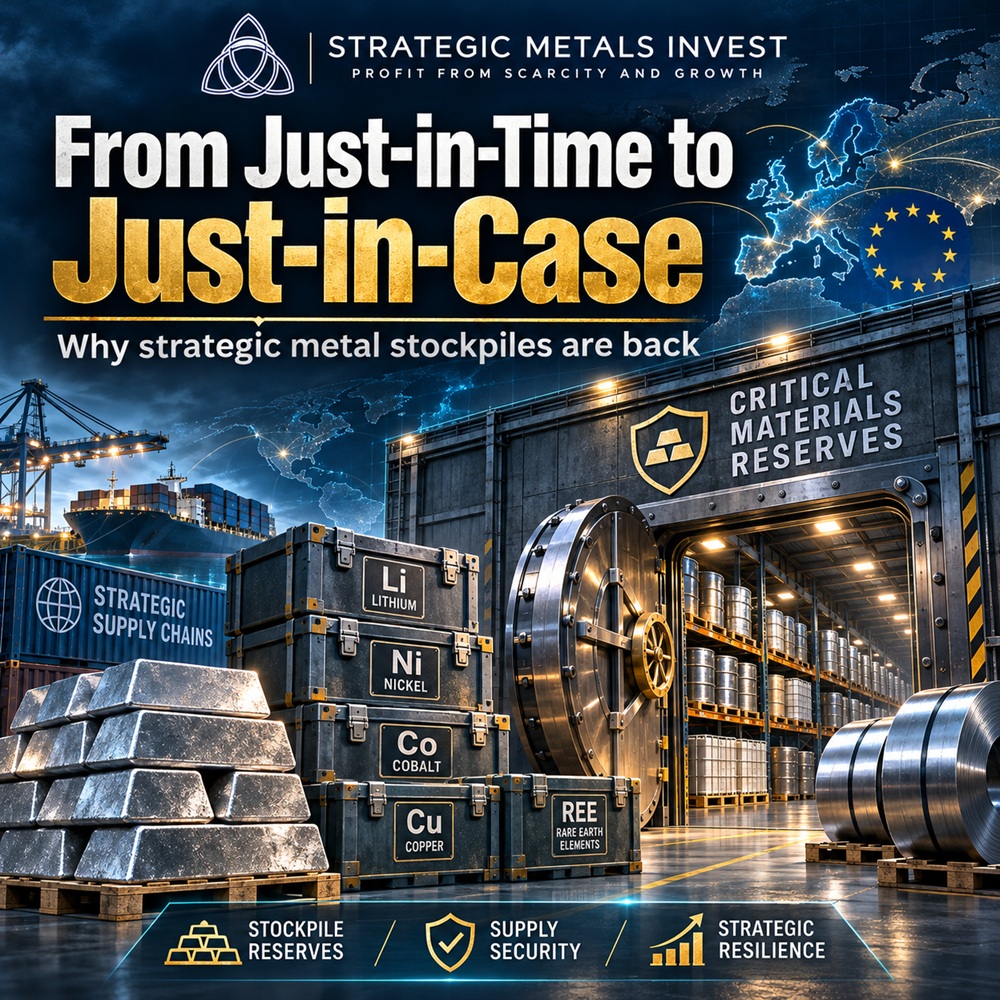
For decades, modern industry operated on a simple principle: keep inventories lean, avoid tying up capital, and rely on efficient global supply chains to deliver materials precisely when needed.
It was called just-in-time manufacturing, and it worked remarkably well. At least until the supply chains stopped behaving as expected.
Now, something rather interesting is happening. Governments and manufacturers are rediscovering the benefits of having physical materials safely tucked away in a warehouse.
Not because warehouses have suddenly become fashionable, but because running out of a critical raw material can be considerably more expensive than storing it.
And this week, that conversation moved another step up the political ladder.
Germany calls for a European strategic stockpile
On November 5, German Chancellor Friedrich Merz called for the European Union to build strategic reserves of critical raw materials.
Speaking at an economic conference in Berlin, Merz argued that Europe must reduce its dependence on countries dominating the extraction and processing of essential materials. He called for greater supply diversification, more recycling, and coordinated stockpiling at the European level.
This is an important development, particularly coming from Germany, whose automotive, engineering, chemical, and advanced manufacturing industries depend heavily on reliable international supply chains.
It also reflects a broader change in European thinking.
The EU’s RESourceEU Action Plan, introduced in December 2025, already envisaged coordinated stockpiling, joint purchasing, and a European Critical Raw Materials Centre.
Merz’s latest intervention gives that ambition renewed political weight.
The key distinction is that Europe is still developing this approach. It has not suddenly created a fully functioning strategic stockpile overnight.
But the direction is clear: Europe is beginning to treat critical raw materials the way it has long treated other essential resources—as something that must be secured before a crisis arrives.
When efficiency becomes vulnerability
The economic logic behind just-in-time manufacturing was compelling.
Why pay to store six months of material when reliable suppliers could deliver what you needed next week? Why tie up working capital in inventory when that money could be invested in production, technology, or expansion?
For many industries, the approach helped lower costs and improve efficiency.
But it relied on several assumptions:
- Reliable suppliers: Materials would remain available when required.
- Predictable logistics: International transport and shipping routes would function without major disruption.
- Open trade: Export permissions and regulatory requirements would remain reasonably predictable.
- Flexible markets: If one supplier encountered difficulties, another could step in.
Those assumptions have become increasingly difficult to defend in strategic-metal markets.
China’s export controls on rare earths, gallium, germanium, and other critical materials have demonstrated how quickly access can change. Manufacturers that once viewed supply as a routine purchasing decision now face licensing uncertainty, unpredictable delivery schedules, and limited alternatives.
The International Energy Agency (IEA) reported that China’s April 2025 rare-earth export restrictions contributed to some automotive manufacturers reducing production or temporarily shutting facilities.
That is the uncomfortable reality.
A factory does not need a metal to become extraordinarily expensive before it has a problem. It only needs the metal to stop arriving.
The cost of having nothing
Consider the economics of a modern factory.
An electric-vehicle manufacturer may require relatively small quantities of dysprosium or terbium within its permanent magnet supply chain. An aerospace manufacturer may depend on specialised superalloys containing rhenium or hafnium. A semiconductor producer may require specific gallium or germanium compounds.
In each case, the quantities can be tiny compared with the value of the finished product.
But those materials cannot always be replaced at short notice.
If a component cannot be manufactured because one essential ingredient is unavailable, the economic consequences extend far beyond the value of the missing metal.
Production lines may stop. Deliveries may be delayed. Contracts may be affected. Workers and expensive machinery may sit idle while procurement teams desperately search for alternative sources.
Suddenly, that warehouse full of material does not look like inefficient capital.
It looks like insurance.
This is where the shift from just-in-time to just-in-case becomes interesting.
The objective is no longer simply to minimise inventory costs. It is to minimise the combined cost of procurement, storage, and potential disruption.
That is a very different calculation.
Strategic stockpiling is nothing new
Although Europe is increasingly discussing coordinated reserves, the underlying concept is well established.
Japan, South Korea, and the United States have maintained strategic mineral stockpiles for years, recognising that certain materials are too important to leave entirely to commercial supply chains.
Their systems operate through specialist government agencies:
- Japan: The Japan Organization for Metals and Energy Security (JOGMEC) manages strategic mineral reserves.
- South Korea: Stockpiling is coordinated through institutions including the Korea Mine Rehabilitation and Mineral Resources Corporation (KOMIR) and the Public Procurement Service.
- United States: The National Defense Stockpile, managed by the Defense Logistics Agency, maintains strategic materials for national defence requirements.
These arrangements differ in their ownership structures, materials held, and release mechanisms. Nevertheless, they share the same underlying purpose: providing a buffer when normal supply channels become unreliable.
The IEA’s January 2026 analysis of strategic mineral stockpiling describes such reserves as an important way to protect industrial activity during temporary supply disruptions.
Importantly, stockpiles are not intended to replace long-term supply diversification.
They buy time.
And in a supply crisis, time can be an extraordinarily valuable commodity.
Why certain strategic metals deserve particular attention
Not every metal needs the same level of inventory protection.
Bulk industrial commodities have different market structures from specialised technology metals, many of which are produced in relatively small quantities and traded through specialist industrial channels.
The IEA identifies several materials as particularly exposed to supply disruptions because of concentrated production, limited substitution options, and their importance to critical technologies.
Among those most relevant to strategic-metal investors are:
- Gallium: Essential for compound semiconductors, power electronics, and advanced communications.
- Germanium: Used in fibre optics, infrared imaging, specialised semiconductors, and defence technology.
- Dysprosium and terbium: Heavy rare earths that help high-performance permanent magnets operate reliably under demanding conditions.
- Neodymium and praseodymium: Core ingredients in powerful permanent magnets used in electric motors, wind turbines, and industrial equipment.
- Tellurium: An important material for certain thin-film solar technologies, with supply largely dependent on copper refining.
The common denominator is not simply that these materials are difficult to obtain.
It is that their absence can have consequences far greater than their relatively modest physical volumes suggest.
Several are also produced as by-products of other metals, meaning supply cannot easily expand in response to sudden demand.
That is not an ideal situation for a manufacturer operating on minimal inventory.
Is stockpiling really that expensive?
This is where the economics become surprisingly interesting.
Stockpiling requires money, of course. Governments or companies must purchase the material, arrange suitable storage, insure it, manage inventories, and occasionally replace or rotate holdings.
But the costs need to be viewed in context.
In its Global Critical Minerals Outlook 2026, the IEA estimated that the combined net annual cost of stockpiling 11 high-risk materials across countries outside the dominant supplier would be less than $900 million under its assessed framework.
That may sound substantial.
Yet it is modest compared with the potential economic damage caused by disruptions to major manufacturing industries.
There is also a fundamental distinction between purchasing a reserve and consuming money.
When a government buys physical metal, it acquires an asset. The material remains available for future industrial use, release, or resale, although its market value and storage costs can change.
The continuing cost of maintaining that reserve is therefore different from its initial purchase price.
This makes strategic stockpiling a potentially practical form of industrial insurance, especially for materials required in small quantities.
But you cannot stockpile your way out of dependency
There is an important limitation.
Strategic reserves protect against disruptions, but they do not solve the structural reasons those disruptions occur.
A country that relies on China for rare-earth refining does not suddenly become independent because it has several months of material sitting in storage.
Eventually, those reserves must be replenished.
Nor is building a stockpile necessarily easy.
Manufacturers often require precise chemical compositions, purity levels, and physical forms. Some materials need specialised storage conditions, while others must be periodically rotated to preserve their usefulness.
Governments also need to decide:
- Which materials are sufficiently critical to justify reserves?
- How many months of potential disruption should those reserves cover?
- Should governments own the materials directly, or support industry-held inventories?
- Who decides when reserves can be released?
- How can purchases be coordinated without creating additional shortages?
Those are not trivial questions.
Indeed, widespread stockpiling itself can temporarily increase demand in already constrained markets. Poorly coordinated buying could aggravate the shortages governments are attempting to protect against.
This is why the IEA emphasises careful planning, industry participation, appropriate storage, and international coordination.
Stockpiling is part of the solution.
It is not the whole solution.
Physical ownership takes on a different meaning
For private investors, this development raises an interesting question.
If governments and manufacturers increasingly believe that holding physical strategic materials has value, what does that tell us about the underlying market?
First, it reinforces the distinction between strategic metals and many conventional financial assets.
These materials are not primarily valuable because investors find them fashionable. They are valuable because industries require them to manufacture products, often with limited practical alternatives.
Second, it demonstrates that physical availability is becoming an increasingly important consideration.
A manufacturer facing a supply interruption cannot solve its problem with a financial forecast or a promising mining-company presentation. It needs qualified material that can actually enter its production process.
Finally, it highlights the importance of professional sourcing, documentation, storage, and access to industrial buyers.
Strategic metals are not ordinary retail commodities. Many are traded in specialised physical markets, where purity, packaging, provenance, and established relationships matter.
That is why physical ownership requires a different approach from purchasing exchange-traded investments.
There is, however, an important distinction between private metal ownership and government stockpiling. Public reserves are designed to maintain essential supply during emergencies, while private investors hold metals for their own financial objectives.
The two activities are not interchangeable, and neither eliminates the risks of price volatility, storage costs, or limited resale liquidity.
Nevertheless, they share an important underlying reality: physical access to strategically important materials has economic significance.
A new kind of demand for strategic metals?
The growing interest in strategic reserves could introduce an additional source of demand in certain critical-metal markets.
Traditionally, demand has been driven primarily by industrial consumption. A manufacturer purchases material to produce a component, which ultimately becomes part of a finished product.
Strategic stockpiling adds another dimension.
A government or manufacturer may purchase material not because it needs to consume it immediately, but because it wants the security of knowing the material will be available later.
The distinction matters.
In markets where supply is highly concentrated and production cannot expand quickly, even relatively small additional purchasing programmes can influence availability.
But this is not automatically a recipe for higher prices.
Stockpiles may eventually be released, alternative supply projects may succeed, industrial demand may change, and governments can revise their policies.
The significance lies less in predicting a particular price movement and more in recognising that security of supply is becoming a formal part of purchasing decisions.
For strategic metals, that is an important structural development.
The bottom line
For decades, much of modern industry treated inventory as something to minimise.
Now governments are rediscovering why keeping essential materials in reserve can be a strategic advantage.
Germany’s latest call for European critical-mineral stockpiles adds to a growing international recognition that reliable access to raw materials cannot always be taken for granted.
The United States, Japan, and South Korea already operate strategic reserve systems. Europe is exploring how to develop its own coordinated approach.
And manufacturers are increasingly reassessing the balance between low inventory costs and the potential consequences of supply disruption.
The underlying message is straightforward.
The most expensive strategic metal may not be the one with the highest price. It may be the one you cannot obtain when you need it.
The world is beginning to realise that physical availability deserves a place alongside efficiency, cost, and technological innovation in industrial planning.
The era of just-in-time is not necessarily over.
But for critical raw materials, just-in-case is becoming much harder to ignore.
At Strategic Metals Invest, we provide private investors with access to selected physical rare earths and technology metals through established industrial supply chains, professional storage, and structured resale arrangements.
Interested in adding physical strategic metals to your portfolio? Contact us to arrange a call and learn more about the metals available, how physical ownership works, and the risks and practical considerations involved.