
Weekly News Review November 9 – November 15 2026
November 15, 2026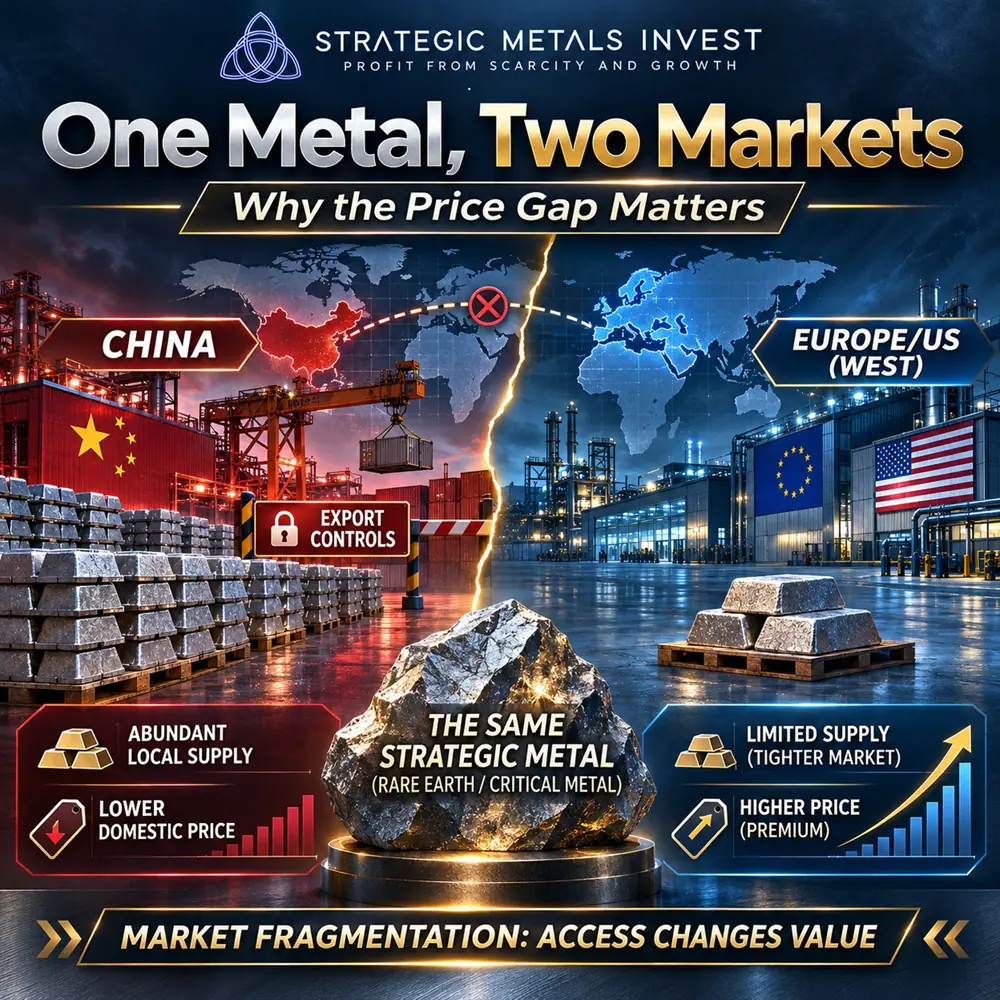
Imagine two manufacturers trying to buy exactly the same strategic metal.
One is based in China. The other operates a factory in Europe.
Both need the same material, at the same purity, for the same industrial application. Yet one may be able to source it locally at a fraction of the price quoted to the other.
How is that possible?
After all, dysprosium is dysprosium. Gallium is gallium. Germanium does not suddenly become a different chemical element when it crosses a border.
But in today’s strategic-metals market, where a material is located—and whether it can actually reach the buyer—can be almost as important as the material itself.
Welcome to a market increasingly divided by geography, regulation and geopolitics.
A diplomatic reprieve, but not an open market
On November 9, China announced that it would extend the suspension of certain additional rare-earth export controls until January 10, 2027.
The announcement followed ongoing trade negotiations between Beijing and Washington and was generally welcomed as another sign that both sides were trying to avoid further escalation.
But there was an important detail.
The additional measures have been postponed, not abolished. More importantly, China’s earlier export restrictions remain firmly in place.
Those existing controls cover several strategically important rare earths, including dysprosium and terbium, and require exporters to obtain approval before shipping covered materials overseas.
Gallium and germanium remain subject to their own licensing requirements, introduced in August 2023. A separate suspension of restrictions specifically targeting exports to the United States is currently scheduled to expire on November 27, unless extended.
The distinction matters because a diplomatic agreement does not automatically translate into improved physical availability.
Manufacturers still need export approvals. Shipments can still be delayed. And material that is readily available within China may remain extremely difficult to obtain elsewhere.
That is where the story of two markets begins.
When one metal develops two different prices
The International Energy Agency highlighted this phenomenon in its Global Critical Minerals Outlook 2026.
Using market data from early 2026, the IEA found that:
- Gallium: European prices were approximately five times Chinese domestic levels.
- Dysprosium and terbium: European heavy rare-earth prices were also around five times Chinese levels.
- Germanium: European prices were almost three times those in China.
These were market assessments from earlier in the year, not current transaction quotations. Subsequent developments have continued to affect the differences between regional markets.
Nevertheless, the underlying message is remarkable.
We are not comparing different metals or entirely different industries. We are looking at comparable materials trading in markets that have become increasingly disconnected.
The metal has not become five times rarer simply because it is sitting in a European warehouse rather than a Chinese one.
What has changed is access.
Chinese manufacturers can often source material within an established domestic production and refining network. Western manufacturers, meanwhile, may have to compete for whatever limited material has already left China or can be sourced through alternative suppliers.
That creates two very different supply-and-demand situations.
China controls more than production
China’s influence over strategic metals has traditionally been explained by its dominance in mining and refining.
That remains important, but the export licensing system has added another dimension.
Beijing can influence not only how much material is produced, but also how much reaches international markets, which destinations receive shipments, and which industrial applications qualify for approval.
The resulting uncertainty has become a major challenge for manufacturers.
TRADIUM’s analysis of three years of gallium and germanium export controls highlights how licensing requirements have altered procurement behaviour. Companies now face additional documentation, longer approval times, and reduced certainty over when material will arrive.
Even when exports are technically permitted, reliable delivery is not guaranteed.
Consider the difference between two manufacturers:
- Manufacturer A, operating in China, can purchase qualified material through established domestic industrial channels.
- Manufacturer B, operating in Europe or the United States, must find a supplier with suitable material, confirm the required specifications, navigate export rules where applicable, and arrange international transport.
Both manufacturers may need precisely the same material.
But their procurement risks are fundamentally different.
And in industrial markets, risk has an economic cost.
The export figures tell their own story
The effect becomes clearer when looking at actual shipments.
In October, TRADIUM published China’s export statistics for September 2026.
The figures showed how dramatically availability can fluctuate:
- Dysprosium: Exports fell to approximately 360 kilograms, with South Korea receiving the entire volume.
- Terbium: Shipments declined to roughly 840 kilograms, with most material going to Vietnam.
- Germanium: Exports dropped to approximately 570 kilograms, following a much stronger August.
- Gallium: Shipments rebounded to approximately 2,030 kilograms after an exceptionally weak previous month.
These are not enormous quantities.
In fact, that is precisely the point.
Strategic-metal markets can be remarkably small, and movements of a few hundred or a few thousand kilograms can have a meaningful impact on availability.
There is also an important distinction between raw materials and finished products.
TRADIUM noted that while direct shipments of dysprosium and terbium to Europe had largely dried up, China continued exporting substantial quantities of finished rare-earth magnets to major industrial countries.
That is a fascinating situation.
A European manufacturer may still be able to purchase finished magnets containing Chinese rare earths while struggling to obtain the underlying raw materials needed to manufacture those magnets independently.
The finished product crosses the border.
The raw material may not.
This is one reason why building independent Western processing and magnet-manufacturing capacity remains so challenging.
Why the price difference doesn’t simply disappear
In a normal, freely functioning market, significant regional price differences create opportunities for traders.
If a product costs substantially less in one location than another, traders buy it in the cheaper market, transport it to the more expensive market, and sell it.
That process, known as arbitrage, tends to narrow the price difference.
But strategic metals do not always behave like freely traded commodities.
A trader cannot simply purchase several tonnes of dysprosium in China and ship them to Europe because the European quotation looks more attractive.
Export licences may be required. Approvals may be delayed or denied. Qualified material may already be committed to existing industrial customers.
There are also practical differences between quotations.
When comparing strategic-metal prices, buyers need to consider:
- Purity and specification: The same metal can be sold in different industrial grades and chemical forms.
- Location: A Chinese domestic quotation is not equivalent to material already available in a European warehouse.
- Delivery terms: Transport, insurance, customs, financing and handling can affect the final cost.
- Availability: A published price assessment does not necessarily mean material can be purchased immediately at that level.
- Transaction size: Small purchases and large industrial contracts may be priced differently.
- Purchase and resale spreads: An industrial dealer’s selling quotation is not the same as the price it would offer to repurchase material.
For these reasons, apparent price gaps should not be interpreted as straightforward or risk-free trading opportunities.
And because many strategic metals trade through specialised over-the-counter markets rather than a centralised exchange, published prices may be assessments of relatively limited physical trading activity.
Understanding what a quotation actually represents is just as important as knowing the number.
Not all rare earths are following the same path
Another interesting development is that the divide between Chinese and Western markets is not uniform across every rare earth.
Neodymium and praseodymium, two important ingredients in high-performance permanent magnets, have generally experienced different supply dynamics from heavier rare earths such as dysprosium and terbium.
One reason is the gradual development of alternative production outside China.
Projects in Australia, the United States and elsewhere are increasing the availability of certain light rare earths. While China remains dominant in downstream processing, the emergence of alternative supply has begun to change the market balance.
Heavy rare earths present a more difficult challenge.
Dysprosium and terbium are produced in smaller quantities, require complex separation processes, and remain heavily dependent on concentrated supply chains.
TRADIUM’s Q3 2026 Market Report describes how Western inventories of these materials have been running down while Chinese exports remained restricted.
The resulting price differences underline why it is dangerous to treat rare earths as one homogeneous commodity.
Every metal has its own market.
Its own supply structure.
Its own industrial applications.
And increasingly, its own geopolitical exposure.
Is the market becoming permanently divided?
It is tempting to assume that these regional differences will persist indefinitely.
That would be premature.
Export controls can change. Diplomatic agreements can improve access. New refining capacity may come online, and recycling may eventually contribute more meaningful quantities of material.
Western manufacturers are also increasingly willing to support alternative supply chains through long-term purchase commitments, strategic partnerships, and higher prices for secure non-Chinese material.
Over time, those developments could narrow the gap.
But building alternative supply chains is neither quick nor inexpensive.
China’s competitive advantage reflects decades of investment in processing technology, industrial infrastructure, technical knowledge and manufacturing expertise.
Recreating that ecosystem will take time.
And until it becomes sufficiently established, access to certain strategic materials outside China is likely to remain vulnerable to political decisions and supply disruptions.
There is also another possibility worth considering.
If export controls were eased substantially, previously restricted material could return to international markets, potentially putting downward pressure on prices.
That is why the current price differences should be viewed as evidence of market disruption, not as guarantees of future returns.
What this means for private investors
For private investors, the emergence of increasingly distinct regional markets reinforces an important characteristic of physical strategic metals.
Unlike traditional exchange-traded investments, their value depends on the realities of industrial supply chains.
Where is the material?
What specification does it meet?
Is it properly documented and professionally stored?
Can it be sold back into the industrial market?
And, crucially, what are qualified buyers prepared to pay for material they can actually obtain?
These are practical questions rather than abstract financial ones.
They also help explain why physical strategic-metal ownership differs from buying shares in a mining company or trading a financial instrument.
Owning physical metal does not eliminate market risk. Prices may fall, alternative supplies may emerge, and liquidity depends on industrial demand and available trading channels.
But it provides direct ownership of a material whose relevance is grounded in real industrial applications.
For investors considering strategic metals as part of a diversified portfolio, understanding these market structures is essential.
It is not enough to know what a metal is worth on paper.
You need to understand the market in which it can actually be bought and sold.
The bottom line
For decades, globalisation encouraged us to think of commodity markets as increasingly interconnected.
A tonne of material produced in one country could generally find its way to an industrial customer on the other side of the world, provided the buyer was willing to pay.
Strategic metals are demonstrating that the reality can be rather different.
China’s export controls have helped create situations where the same material may be relatively accessible domestically but scarce and considerably more expensive elsewhere.
And despite diplomatic efforts to ease trade tensions, the underlying supply-chain vulnerabilities remain.
The result is not quite one global market operating under the same conditions for everyone.
It is a series of interconnected but increasingly fragmented physical markets, where geography, regulation and availability influence pricing.
For investors, that leads to a simple but important conclusion:
The value of a strategic metal is not determined solely by how much exists. It is also shaped by who can actually obtain it.
As governments and manufacturers invest in alternative supply chains, that reality is becoming increasingly difficult to ignore.
At Strategic Metals Invest, we provide private investors with access to selected physical rare earths and technology metals through established industrial supply chains, professional storage and structured resale arrangements.
Interested in adding physical strategic metals to your portfolio? Contact us to arrange a call and learn more about the metals currently available, how physical ownership works, and the risks and practical considerations involved.