Weekly News Review May 25 – May 31 2026
May 31, 2026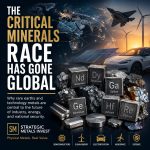
The Critical Minerals Race Has Gone Global
June 11, 2026
Investment, diversification, and international cooperation have shaped this week’s critical minerals landscape. New initiatives in Brazil, France, Canada, and South Korea demonstrate how governments and industry are working to secure long-term supply chains for rare earths and critical minerals.
CANADA AND SOUTH KOREA DEEPEN COOPERATION ON CRITICAL MINERALS:
The two countries will develop a joint stockpiling plan by the year’s end.
Canada and South Korea will work more closely together on critical minerals, agreeing among other things to develop a joint stockpiling plan by the end of 2026, the most concrete outcome of a meeting between Minister of Energy Tim Hodgson and Kang Hoon-Sik, South Korea’s Special Envoy for Strategic Economic Cooperation, in Ottawa on Tuesday. Both governments described the move as a shift toward a “fully integrated energy supply chain partnership.”
The agreement builds on an existing memorandum of understanding between the two countries and covers priority areas, including investments in strategic natural resources, joint stockpiling, and policy measures to stabilize energy supplies. The two governments also welcomed a new research collaboration on naturally occurring hydrogen between their respective geological survey agencies.
The deal reflects mounting pressure on both nations to diversify away from China’s dominance over key materials. South Korea, a high-tech manufacturing powerhouse, remains heavily reliant on Chinese imports for critical minerals, including gallium, germanium, and rare earth elements, and has been pushing to build alternative supply chains.
Canada, for its part, has been aggressively courting partners to develop its natural resources, having recently mobilized nearly $9 billion in critical minerals investments through 30 international project agreements.
Beyond minerals, the partnership also deepens energy ties: South Korea plans to import at least 1.4 million tons of Canadian LNG annually for over 30 years once LNG Canada Phase II comes online in the early 2030s and has agreed to extend preferential tariff treatment to Canadian crude imports under the existing free trade agreement between the two countries.
USA RARE EARTH SIGNALS MAJOR INVESTMENT IN FRANCE:
The U.S.-based company plans to establish a rare earth value chain in France, from raw materials to magnets.
USA Rare Earth plans to further expand its operations in Europe. The U.S.-based company has announced additional investments of more than €175 million by 2030. The funding will support new capacity for rare earth metals, alloys, and magnets.
At the same time, more than 300 new jobs could be created in the region, the company said during the Choose France Summit. At the economic summit, initiated by Emmanuel Macron, Paris seeks to attract international investment in industry, technology, and infrastructure.
The plans build on projects the company has already announced. These include a facility in Lacq, southwestern France, operated by the recently acquired Less Common Metals, focused on producing rare earth metals and alloys. In addition, the company holds a strategic stake in Carester, which is advancing rare earth processing and separation at the same site. The goal is to build a resilient regional value chain spanning from raw materials to finished magnets.
Support from the French government could further strengthen the project. This would reinforce Lacq’s position as an increasingly important European hub for rare earth processing.
EU UNVEILS ITS CHIP INDUSTRY RESET:
The EU Chips Act, adopted in 2023, was designed to significantly strengthen Europe’s domestic semiconductor industry. Its headline goal was ambitious: doubling Europe’s share of global chip production to 20 percent by 2030. A key instrument was the provision of subsidies to support the construction of new semiconductor manufacturing facilities.
However, the rollout of the Chips Act has faced criticism for its slow implementation, particularly after Intel’s withdrawal from several flagship European projects.
While the European Commission argues that the legislation has already catalyzed €52 billion in investments and can therefore be considered a success, policymakers are now moving ahead with an updated framework. A draft of the Chips Act 2.0 was published on Wednesday as part of the broader Tech Sovereignty Package.
A Focus on the Entire Value Chain:
Unlike its predecessor, the new initiative no longer concentrates solely on expanding manufacturing capacity. Instead, the EU aims to strengthen the entire semiconductor value chain, from raw materials to advanced packaging. The focus is also shifting toward the demand side of the market, with policymakers seeking to stimulate the adoption of European-made chips. To connect manufacturers with potential buyers, the proposal introduces measures such as public procurement programs and long-term purchasing agreements.
European start-ups and scale-ups are expected to be among the primary beneficiaries. At the same time, the EU intends to accelerate approvals and investment flows for strategically important technologies, particularly AI chips. State aid for innovative semiconductor projects across the supply chain—from materials and production to packaging—would be fast-tracked under the proposal. Additional measures include introducing a new excellence label for Europe’s leading semiconductor regions and expanding international partnerships with major global chip hubs.
The Road Ahead:
Beyond the Chips Act 2.0, the proposed legislative package includes measures to reduce Europe’s dependence on the United States and China for critical technologies such as artificial intelligence and cloud computing. Before the package can take effect, it must secure approval from both the European Parliament and the Council of the European Union.
EUROPE: BELGIUM’S SOLVAY SECURES ACCESS TO RARE EARTHS IN BRAZIL:
Letter of intent signed with Viridis. Neodymium, terbium, and other rare earth elements from the Colossus project to be processed in La Rochelle, France.
Belgian chemicals group Solvay is playing a key role in building Europe’s rare earth value chains. In La Rochelle, in southwestern France, the company operates one of the few facilities outside China capable of separating these critical raw materials. In the future, part of its feedstock is expected to come from Brazil, following the signing of a letter of intent with Viridis Mining and Minerals.
The Australian mining company is developing the Colossus Project deposit in the Brazilian state of Minas Gerais. According to geological studies, the site is believed to be a rich source of highly sought-after heavy rare earth elements, which are currently refined almost exclusively in China. Viridis announced only a few days ago that it intends to prioritize supplying Western customers with materials from the project.
The partnership with Viridis represents an important step toward strengthening and diversifying the supply chain, said An Nuyttens, President of Solvay’s Special Chem business unit. It also supports the company’s ambition to cover around 30 percent of Europe’s demand for rare earths used in permanent magnets by 2030.
Solvay’s refinery in La Rochelle has been in operation since 1948, with the range of processed rare earths steadily expanding over time. While earlier decades focused mainly on cerium and lanthanum—used, for example, in catalytic converters and polishing applications—the company has increasingly shifted toward magnet materials such as neodymium and praseodymium.
Starting in September this year, the facility is also expected to be capable of separating the heavy rare earth elements terbium and dysprosium, according to Nuyttens.