
Weekly News Review June 1 – June 7 2026
June 7, 2026
Weekly News Review June 8 – June 14 2026
June 14, 2026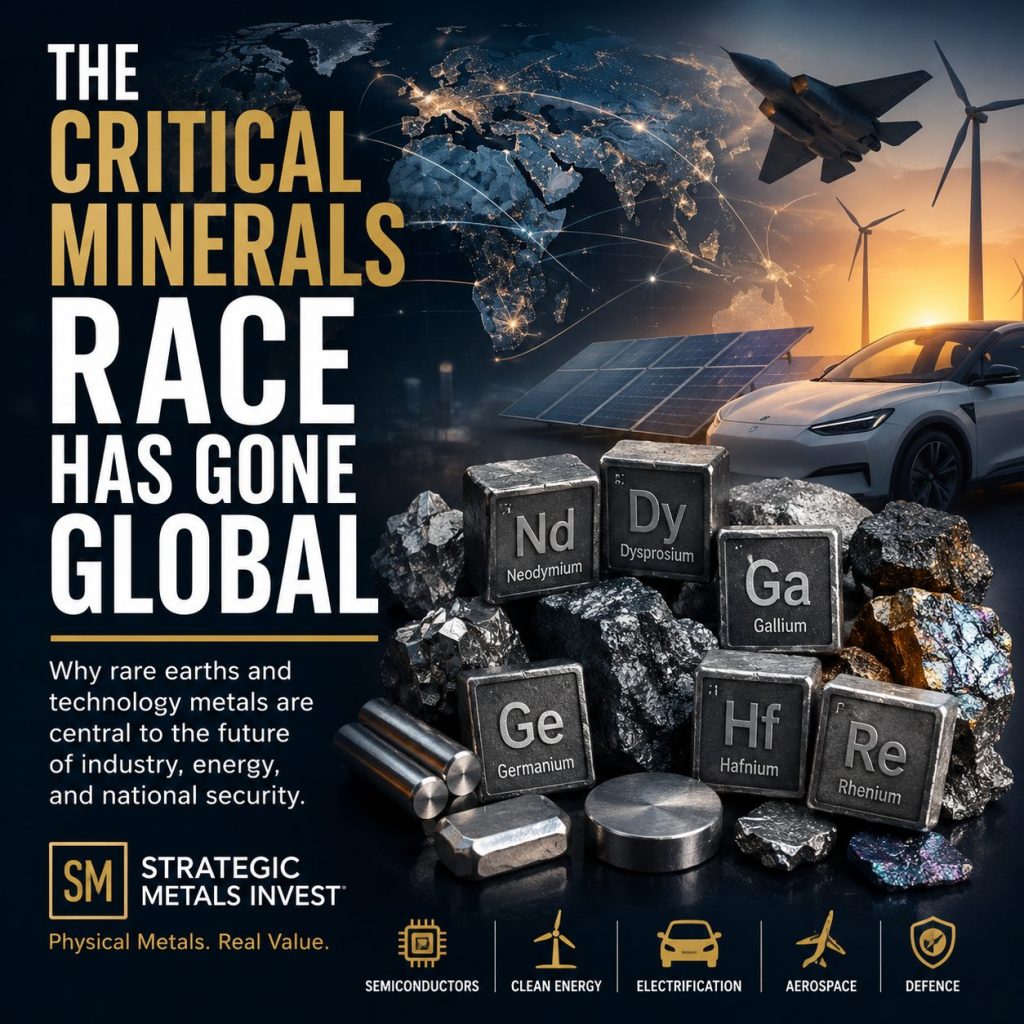
For decades, critical minerals were the sort of topic that lived quietly in the footnotes of industrial reports. Important, yes. Exciting, not exactly. The kind of thing procurement departments worried about while the rest of the world got on with talking about oil, gold, interest rates, and stock markets.
Not anymore.
Critical minerals have escaped the footnotes. They are now sitting in ministerial meetings, trade negotiations, defence briefings, and boardroom strategy sessions. Governments are forming alliances. Countries are talking about joint stockpiles. Industrial buyers are trying to secure supply before the next disruption arrives. And somewhere in the background, China is still holding many of the best cards.
Welcome to the new global minerals race.
This is not a race for shiny trophies. It is a race for the obscure materials that make modern life possible: rare earths for electric motors and wind turbines, gallium and germanium for semiconductors and fibre optics, hafnium and rhenium for aerospace and turbines, indium for screens and advanced electronics.
They may not have the glamour of gold or the swagger of oil, but try building the 21st century without them.
Good luck.
From commodities to strategic assets
The language around raw materials has changed dramatically.
A few years ago, most people still thought of metals mainly as commodities. Something mined, refined, shipped, bought, sold, and occasionally argued over. Today, the same materials are increasingly described as strategic assets.
That change matters.
When a material becomes strategic, price is no longer the only issue. Access matters. Origin matters. Processing capacity matters. Political relationships matter. Stockpiles matter. And, perhaps most importantly, reliability matters.
A factory does not need a metal to be expensive before it becomes a problem. It only needs the metal to be unavailable.
This is the key point many investors still miss. The critical minerals story is not simply about whether a particular metal rises or falls in price this month. The bigger story is that entire industries are discovering just how fragile their supply chains really are.
Stockpiles, alliances, and polite panic
Recent developments show how quickly the mood has changed.
Canada and South Korea have agreed to deepen cooperation on critical minerals, including plans to develop a joint stockpiling strategy by the end of 2026. This is not a symbolic handshake for the cameras. South Korea is an industrial powerhouse with major exposure to batteries, electronics, semiconductors, and automotive manufacturing. Canada has mineral resources, political alignment with Western partners, and growing ambitions to become a trusted supplier.
That is the new model: countries with resources are pairing up with countries that need secure industrial supply.
The European Union is moving in the same direction. Through its Critical Raw Materials Act and related initiatives, Europe is trying to reduce excessive dependence on single suppliers, accelerate key projects, and build more resilient supply chains. The language is bureaucratic, as Brussels language tends to be, but the underlying message is blunt: Europe knows it has a raw materials problem.
The G7 is also trying to coordinate more closely on critical minerals. The goal is clear enough: build supply chains that are more transparent, more democratic, and less vulnerable to political pressure from dominant suppliers.
That all sounds sensible. It also tells us something important.
If governments are suddenly discussing stockpiles, subsidies, offtake agreements, mineral alliances, and domestic processing, it is because the old system no longer feels safe.
China’s long shadow
No discussion of critical minerals can avoid China.
China did not become dominant in many strategic materials by accident. It spent decades building mining, refining, processing, and magnet-making capacity while much of the West outsourced the difficult, dirty, and technically complex parts of the supply chain.
The result is a market structure that looks efficient in calm times and worryingly fragile in tense ones.
China’s export controls on gallium, germanium, and several rare earth-related materials have already shown how powerful that position can be. Export restrictions do not need to be absolute to cause disruption. A licensing process here, a delayed approval there, a sudden change in documentation requirements, and suddenly industrial buyers are no longer asking, “What is the price?”
They are asking, “Can we get the material at all?”
That is a very different conversation.
And it is exactly why critical minerals have become a national security issue. A country that cannot access the materials needed for semiconductors, defence systems, clean energy infrastructure, and advanced manufacturing is not merely facing a commercial inconvenience. It is facing a strategic vulnerability.
Why this matters for strategic metals
At Strategic Metals Invest, we focus on a carefully selected group of rare earths and technology metals that sit directly inside this global story.
Rare earth elements such as neodymium, praseodymium, dysprosium, and terbium are essential for high-performance permanent magnets. These magnets are used in electric vehicles, wind turbines, robotics, defence systems, and advanced electronics.
Technology metals such as gallium and germanium are linked to semiconductors, fibre optics, LEDs, solar technology, infrared optics, and defence applications.
Hafnium and rhenium play critical roles in high-temperature alloys, aerospace, turbines, and advanced industrial systems.
Indium is used in displays, touchscreens, semiconductors, and specialised coatings.
These metals are not famous because they are not consumer products. Nobody buys a new phone and asks how much gallium is inside it. Nobody boards an aircraft and thinks about the rhenium or hafnium hidden in the turbine technology.
But industry knows.
And increasingly, governments know too.
The awkward truth about new supply
The obvious response to supply risk is simple: produce more.
The problem is that critical minerals do not work like turning on a tap.
Many strategic metals are produced as by-products of other mining and refining processes. That means supply cannot always respond directly to demand. If a metal is recovered from zinc, copper, aluminium, or zirconium processing, then its availability is partly tied to the economics of another market entirely.
Even where new projects are possible, they take time. Permitting, financing, environmental approvals, processing technology, local opposition, infrastructure, and customer qualification can stretch development timelines over many years.
Recycling will help, but it is not a magic wand. Many strategic metals are used in tiny quantities inside complex products. Recovering them efficiently, economically, and at industrial scale is far more difficult than simply saying “circular economy” in a policy document.
This is why the race has become so intense. Demand is moving now. Industrial policy is moving now. Defence requirements are moving now. But new supply often moves slowly, carefully, and expensively.
That mismatch is where the tension lives.
What private investors should understand
Most private investors still think of metals through the old lens: gold, silver, perhaps platinum.
Those metals still have their place. But strategic metals are a different kind of tangible asset. They are not primarily driven by jewellery demand, central bank buying, or investor sentiment. Their importance comes from industrial necessity.
They are physical materials required by real-world manufacturers.
That makes them unusual.
They are not traded like normal exchange commodities. They are not easily bought through retail channels. They require specialist sourcing, professional storage, documentation, and an industrial exit route. In other words, the things that make them interesting are also the things that make access difficult.
This is where physical ownership becomes worth understanding.
When properly sourced and professionally stored, strategic metals offer private investors exposure to the materials behind advanced technology, energy infrastructure, aerospace, defence, and electrification. Not through a mining stock. Not through a fund manager’s interpretation of the theme. Not through a promise on a screen.
Through the metal itself.
That does not make them suitable for everyone. Strategic metals are best viewed as medium- to long-term tangible assets, not short-term trading instruments. Markets can be volatile, liquidity works through industrial channels, and each metal has its own supply and demand profile.
But for investors looking beyond traditional assets, the case is becoming increasingly difficult to ignore.
The bottom line
The critical minerals race has gone global because the world has finally realised something manufacturers have known for years:
Modern industry depends on small quantities of highly specialised materials.
Without them, the grand promises of the 21st century start to look rather fragile. No energy transition without magnet metals. No semiconductor independence without technology metals. No advanced aerospace without high-performance alloys. No resilient defence supply chains without secure access to critical inputs.
The world is not running out of headlines about critical minerals.
It is running into the hard reality behind them.
And that reality is physical.
At Strategic Metals Invest, we help private investors understand and access this market through physical ownership of selected rare earths and technology metals, professionally stored and connected to established industrial supply chains.
If you would like to learn how strategic metals can fit into a diversified tangible asset portfolio, please contact us; we are always happy to talk.