

The Critical Minerals Race Has Gone Global
June 11, 2026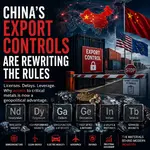
China’s Export Controls Are Rewriting the Rules
June 18, 2026
China reported new export figures, while the United States and Japan put forward different approaches to improving their raw materials security. These were the key developments in a rather quiet week.
CHINA’S RARE EARTH EXPORTS FOR MAY BELOW LAST YEAR’S LEVEL:
Compared with previous months, however, a clear increase is evident.
China exported 5,490 tons of rare earths in May, according to the latest data from the country’s customs authority. This figure falls well below the 5,865 tons recorded a year earlier, representing a 6.4 percent decline. However, exports rose by 3.4 percent compared with April. Against the backdrop of the year-to-date trend, May also marks the highest monthly level so far in 2026.
The statistics cover all 17 elements in the rare earth group—not just the seven particularly critical and highly demanded elements for which Beijing introduced export controls in April 2025. Detailed breakdowns of the export composition are expected in the second half of the month.
COUNTERING CHINA’S DOMINANCE: UNITED STATES EXPANDS CRITICAL MINERALS ALLIANCES –
The House of Representatives passes the DOMINANCE Act to support critical minerals projects in partner countries and facilitate investment.
The U.S. House of Representatives passed the DOMINANCE Act this week. The bipartisan bill aims to strengthen the United States’ supply of critical minerals and reduce its dependence on China. The legislation was introduced by Republican Young Kim and Democrat Ami Bera.
The full name of the bill is the Developing Overseas Mineral Investments and New Allied Networks for Critical Energies Act. It calls for closer cooperation with allies and partner countries in building supply chains for critical minerals. As part of this effort, investments in overseas mineral projects and related infrastructure are to be facilitated. To achieve this, the legislation establishes several new institutions, including an Office of Energy Security Pacts within the U.S. Department of State. The office will coordinate the efforts of various agencies and institutions, including the Department of Energy, the U.S. International Development Finance Corporation (DFC), the Export-Import Bank (EXIM), and the Department of Commerce.
In addition, the bill seeks to strengthen demand for minerals from alternative sources of supply, including through long-term supply and offtake agreements. It also includes measures to support workforce development and training for the mining sector in partner countries.
Support from Industry:
Various organizations from the fields of national security, manufacturing, technology, energy, and public policy have voiced support for the legislation. The U.S. manufacturing association National Association of Manufacturers (NAM), for example, described the initiative as an important step toward building more resilient supply chains. According to the association, U.S. manufacturers depend more than ever on reliable access to critical minerals, while China’s dominance of supply chains represents a growing threat.
The DOMINANCE Act must now be approved by the Senate before it can be sent to the President for signature.
Part of a Broader Critical Minerals Push:
The legislation is the latest in a series of measures aimed at strengthening the United States’ critical minerals supply. These include an executive order signed by President Donald Trump to accelerate domestic production of critical minerals through emergency measures. In recent months, direct government investments in companies along the critical minerals supply chain, including MP Materials and USA Rare Earth, have attracted particular attention.
SHIN-ETSU PLANS NEW RARE EARTH REFINERY IN JAPAN:
Terbium, Dysprosium, and Yttrium. The announcement comes at a time when Japan is increasingly facing restrictions on access to critical raw materials from China.
According to media reports, the Japanese chemical company Shin-Etsu is planning a new rare-earth refinery in Fukui Prefecture. The company is one of the leading manufacturers of rare-earth permanent magnets outside China. It is also among the few non-Chinese players that cover large parts of the value chain.
As reported by Nikkei Asia, the project will involve an investment of approximately $218 million, half of which will be funded through government subsidies. Shin-Etsu already operates two rare earth refineries in the region, Nikkei added. The new facility will focus on dysprosium, terbium, and yttrium, elements that are in high demand for a range of high-tech applications. At the same time, they are among the seven rare earth elements that China placed under strict export controls last year, further tightening an already challenging supply situation.
Japan has been particularly affected by these restrictions. In January, China imposed additional export controls on Japan covering so-called dual-use goods, citing their potential military applications. The measures also apply to critical raw materials, including several rare earth elements.
Japan Seen as a Model for Resilient Supply Chains — With Limits:
Against this backdrop, Shin-Etsu’s announcement can be seen as part of Japan’s broader efforts to reduce its still significant dependence on China for both raw materials and downstream processing. In recent months, Tokyo has intensified these efforts. Japan has long been regarded as a pioneer in building resilient raw material supply chains. The catalyst was a diplomatic dispute in 2010, when China temporarily restricted rare earth exports to Japan. Some observers see parallels between that episode and the current situation.
Nevertheless, a rapid end to import dependence appears unlikely. Competing with China remains difficult. Rare earth refining costs in China are still significantly lower than in Japan, Nikkei quoted Yoshikiyo Shimamine, Chief Economist at the Dai-ichi Life Research Institute in Tokyo, as saying. Rather than competing directly on price, Japan is likely to focus on building a supply chain capable of generating sufficient demand for domestically produced or partner-country rare earth products, even at higher costs.
UPDATE FROM US (STRATEGIC METALS) ON WHEN WE EXPECT SALES TO RESUME AS A RESULT OF THE CHANGE IN GERMAN LAW DECREE:
As many of you would be aware, sales to private investors have been suspended since April 9th. An email was sent by the CEO of Tradium GmbH to all of our existing clients, announcing the sudden notification from the German tax authorities regarding VAT.
To be clear, the core business of Tradium as an industry supplier has not been affected and is business as usual. Also , repurchases have not been affected.
We had a detailed call with Tradium at the end of the week, and more details will be provided.
We will do that via email first with existing clients on Tuesday , and then a general mail-out to our list on Thursday.
We thank you for your patience as we transition through this.